How do I think like a manager for the CISM exam?
The CISM managerial mindset means choosing the answer that best supports governance, risk ownership, business objective, accountability, communication, and repeatable process before jumping to a technical fix.
This matters because many CISM candidates already know the security concepts. They miss questions when two answers look correct and they choose the answer a technician would execute instead of the answer an information security manager should authorize, coordinate, or prioritize.
Decision hierarchy for CISM scenarios
Use this hierarchy when two answers both sound defensible. It is not a shortcut for memorizing answers; it is a way to test whether your decision follows the managerial lens expected in CISM-style scenarios.
- 1Governance - Does the answer support direction, oversight, policy, and accountability?
- 2Risk Ownership - Who owns the risk decision, and is the action within that authority?
- 3Business Objective - Which answer best protects business priorities, not only systems?
- 4Process and communication - Does the answer follow escalation, reporting, and repeatable procedure?
- 5Technical action - Is the technical step now justified by risk, authority, and process?
Technician reflex vs. CISM manager lens
| Technician reflex | CISM manager lens | Trap label |
|---|---|---|
| Fix the vulnerable system immediately. | First confirm risk priority, ownership, change authority, and business impact. | Technical-first bias |
| Choose the strongest control. | Choose the control that matches risk appetite, business need, and governance direction. | Risk-prioritization gap |
| Let security decide because security found the issue. | Clarify business or risk ownership before assigning treatment decisions. | Governance-owner confusion |
| Contain every incident before communicating. | Balance containment with escalation, notification, and incident-response process. | Process/communication skip |
Technical-first bias
Technician reflex:
Fix the vulnerable system immediately.
CISM manager lens:
First confirm risk priority, ownership, change authority, and business impact.
Risk-prioritization gap
Technician reflex:
Choose the strongest control.
CISM manager lens:
Choose the control that matches risk appetite, business need, and governance direction.
Governance-owner confusion
Technician reflex:
Let security decide because security found the issue.
CISM manager lens:
Clarify business or risk ownership before assigning treatment decisions.
Process/communication skip
Technician reflex:
Contain every incident before communicating.
CISM manager lens:
Balance containment with escalation, notification, and incident-response process.
Why the technical answer can still be weaker
We treat "think like a manager" as a set of observable decision errors. When you miss a question by picking a technically correct but managerially weaker answer, you tag it “Answered as technician, not manager”, and Pattern Intelligence shows how often that reason recurs, so the next review targets it instead of simply adding more questions.
Example: fixing a vulnerable system may be technically useful, but it can be the weaker answer if the scenario first requires risk ownership, change approval, stakeholder communication, or business-impact prioritization.
Apply the managerial lens at work
The same judgment appears in workplace governance: before choosing a control, clarify context, risk ownership, decision authority, policy, and oversight. CertArc's NIST CSF 2.0 Govern guide shows how those decisions affect Identify, Protect, Detect, Respond, and Recover.
How CertArc trains it
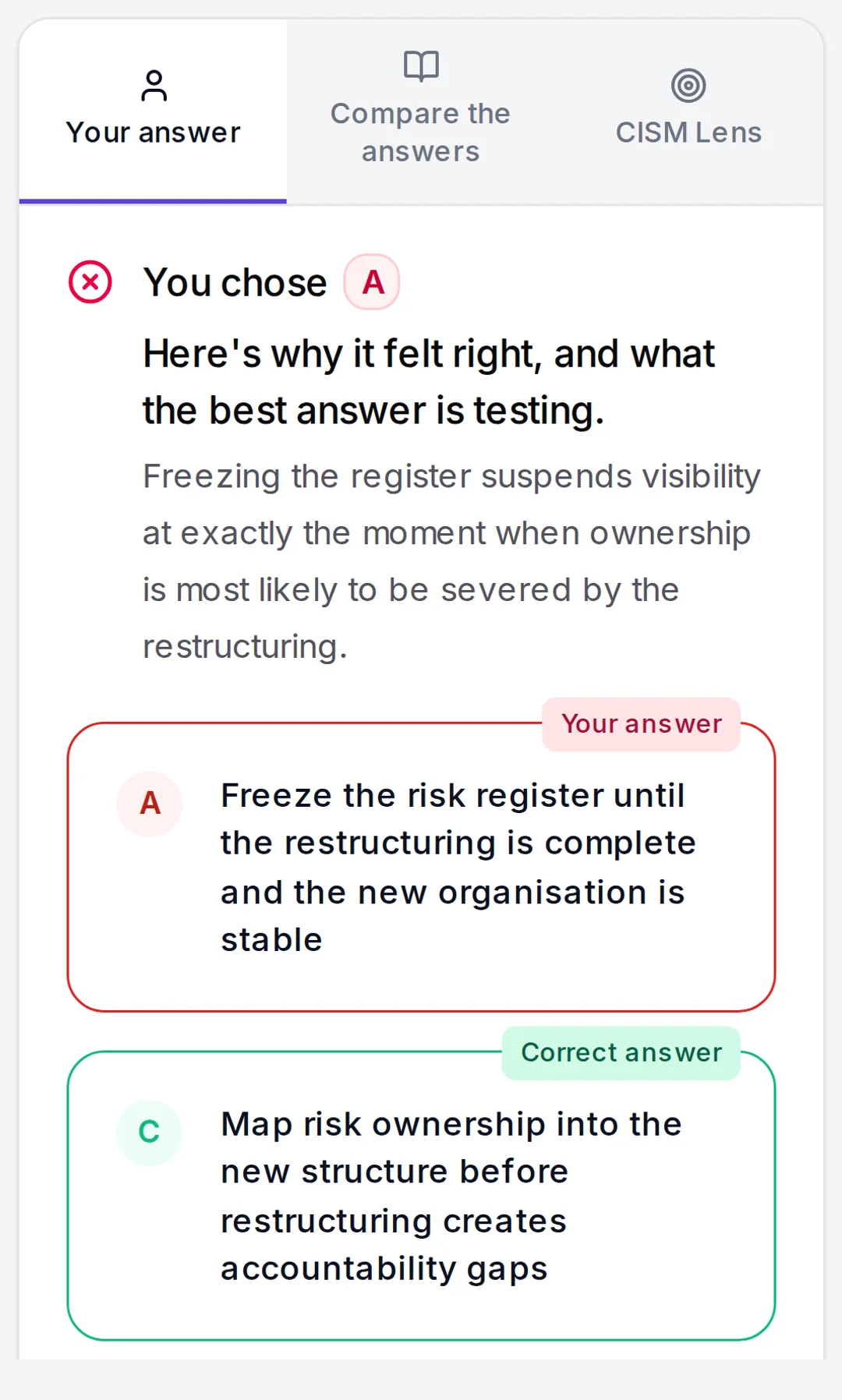
CertArc uses original scenario practice and CISM Lens explanations to show why the tempting answer feels right, what managerial principle it misses, and how the stronger answer aligns with governance, risk, and business objectives. The product tie-in is direct: inside CertArc, the Lens names each question's exam trap, and the reason you tag for each miss feeds Pattern Intelligence.
CISM managerial mindset FAQ
What does it mean to think like a manager for CISM?
It means choosing the answer that best supports governance, risk ownership, business objectives, accountability, communication, and repeatable process rather than only fixing the technical symptom.
Why do technical candidates struggle with CISM questions?
Technical candidates often see the fastest fix first. CISM scenarios often reward the answer that aligns with management responsibility, risk decisions, policy, escalation, or business impact.
How do I choose between two correct CISM answers?
Ask which answer is more managerial: who owns the risk, what business objective is affected, what process or policy governs the action, and whether communication or escalation is required.
Is the managerial answer always less technical?
No. Technical action can be correct when it is the accountable next step. The trap is choosing technical action before the scenario establishes authority, priority, risk, and process.
How does CertArc train this mindset?
CertArc uses original scenario practice, CISM Lens explanations, and the exam trap each Lens names, to show why a tempting answer feels right and why the stronger managerial answer wins.