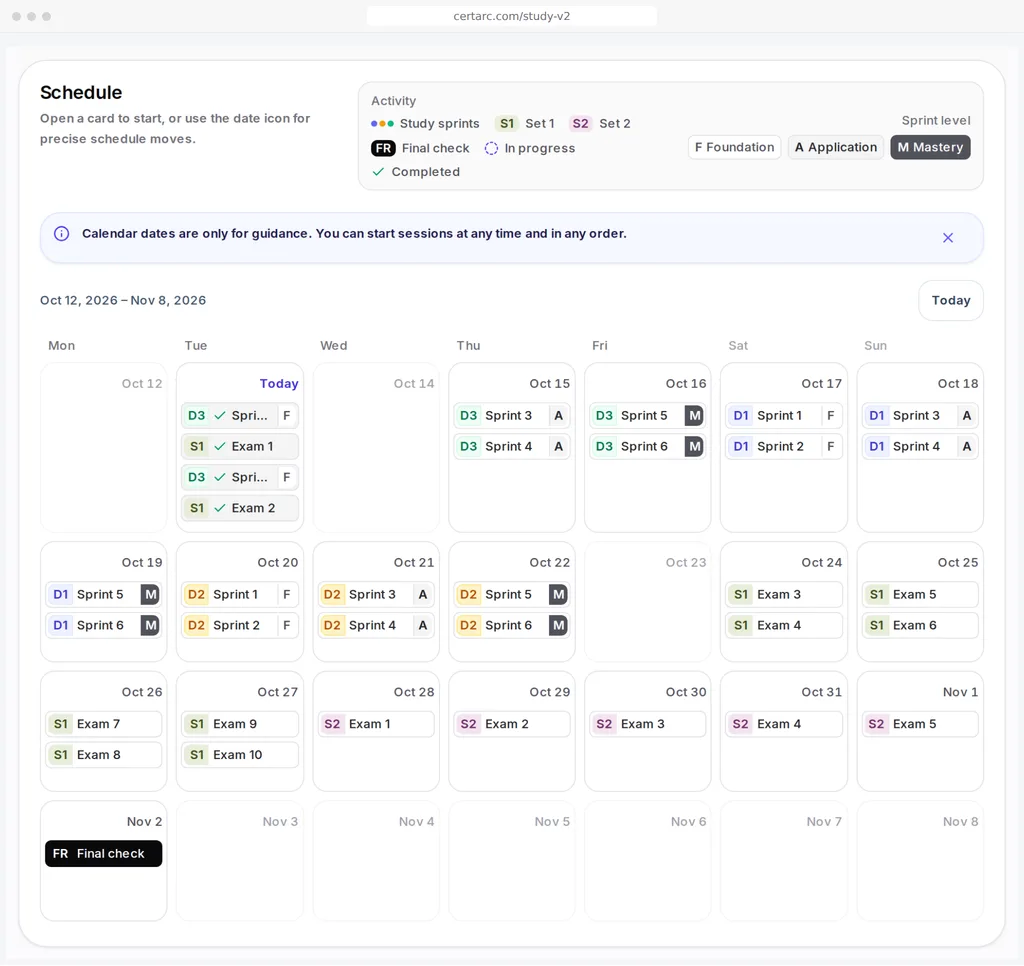
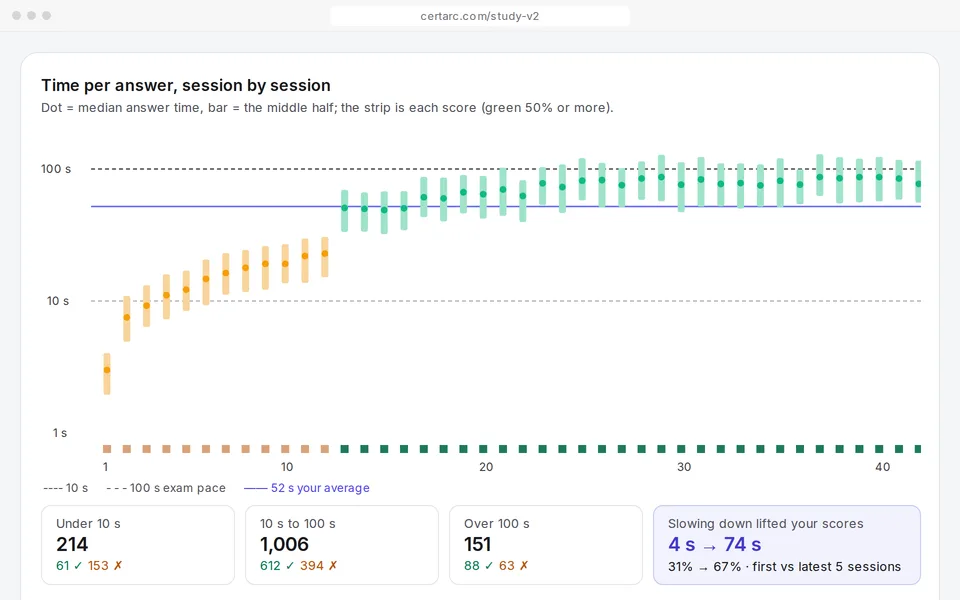
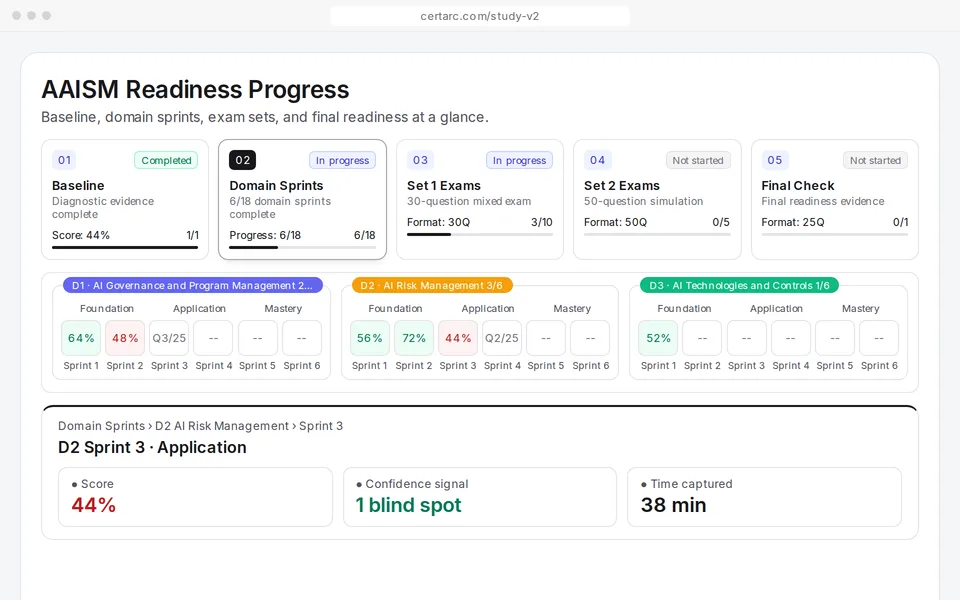
Your 130 free AAISM questions, session by session
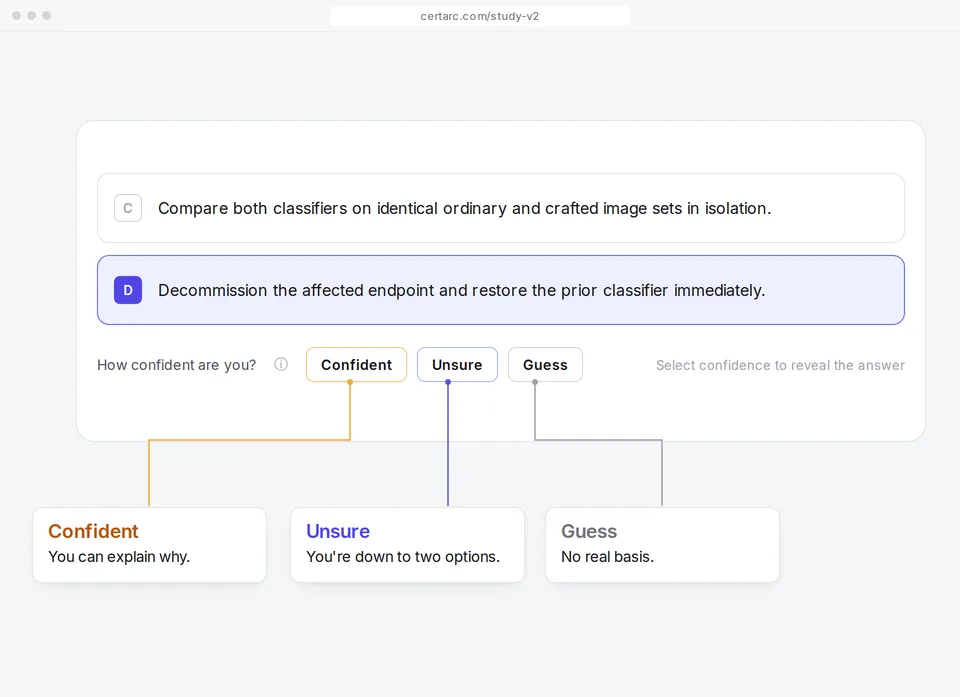
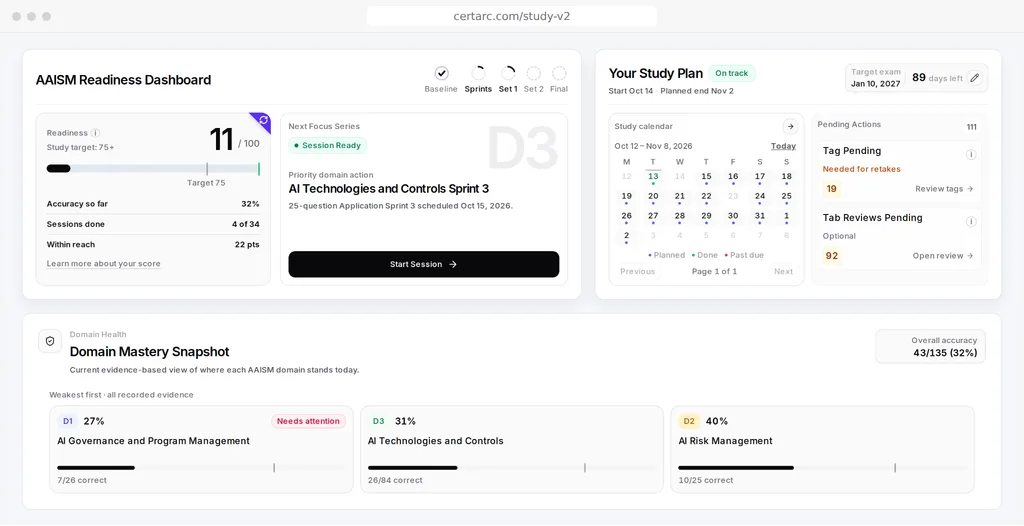
A free CertArc account opens 130 AAISM questions, each with the full review, which compares every option: a 25-question baseline, a 25-question sprint in each of the three domains and a 30-question practice exam, over 21 days with no card. The 10 questions above are a sample you can answer without signing in. ISACA's own free AAISM practice quiz has 12 questions.
| Free session | Questions | What it's for |
|---|---|---|
| Baseline | 25 | Your first readiness picture |
| Domain sprints | 75 (one 25-question sprint per domain) | Practising one domain at a time |
| Practice exam | 30 | The three domains mixed, as on the exam |
| All free questions | 130 | 21 days of free access, no card needed |
Answers to the 10 questions
Try them in the set above first.
Question 1 · AI Governance and Program Management
Question 2 · AI Governance and Program Management
A utility’s AI program manager maintains a guideline permitting AI-drafted customer replies after staff approve the final wording. A proposed live voice assistant would speak new generated replies to callers before staff approval. Which guideline update best fits this use?
- A. Update the guideline to allow direct replies and rely on vendor filters to screen wording.
- B. Update the guideline to allow direct replies and review sampled recordings after calls.
- C. Update the guideline to ban voice suggestions and require fixed scripts for every customer reply.
- D. Update the guideline to allow agent suggestions and limit spoken replies to staff-reviewed wording.
- Correct answer: D. Why this wins
- It adapts the existing customer-reply guideline to the live voice mode while preserving approval before the customer hears generated wording.
- Key takeaway
- When an interface changes when customers receive generated content, carry the organization's existing review condition into that configuration.
- Exam trap
- Vendor filters screen content without staff approval. Sampled recordings support review only after speech reaches callers. Neither satisfies the current pre-delivery approval condition.
Question 3 · AI Governance and Program Management
A restoration laboratory is preparing AI image analysis for its art-authentication service. Its mature security controls have performed well for conventional imaging, and leaders favor applying them unchanged to meet the launch date. The controls have not been assessed for AI development or use, and no AI control framework is mandated. As the AI security manager, which action is best?
- A. Reassess each existing control for the AI use, consulting AI frameworks for guidance on suitable controls.
- B. Map the existing controls to relevant AI-framework categories and accept category coverage as evidence that the controls are effective for the AI use.
- C. Replace the existing controls with the full catalog of one AI framework before launch.
- D. Add access controls around the AI interfaces, leaving the remaining existing controls unchanged.
- Correct answer: A. Why this wins
- It directly tests the unsupported assumption in the scenario. AI development and use require reexamining whether existing controls remain effective; frameworks can help select suitable controls.
- Key takeaway
- Choose the action that validates control effectiveness in the new AI context without discarding mature controls or elevating one framework into a mandate.
- Exam trap
- Mapping controls to AI-framework categories is attractive because it produces a structured artifact. Accepting category coverage as evidence assumes effectiveness that has not been assessed for AI development or use.
Question 4 · AI Risk Management
A satellite-imagery reseller integrated a downloaded pretrained classifier. Since integration, ordinary images are misclassified, and crafted images induce similar errors. The prior in-house classifier remains runnable, and you may test both classifiers in isolation. Which action best distinguishes an imported-component problem from inference-time evasion?
- A. Compare imported-classifier failures from crafted images with current production logs.
- B. Review input-validation rules for gaps affecting the imported classifier.
- C. Compare both classifiers on identical ordinary and crafted image sets in isolation.
- D. Decommission the affected endpoint and restore the prior classifier immediately.
- Correct answer: C. Why this wins
- It uses every discriminating fact supplied: two runnable classifiers, two image categories, and isolated testing that can separate component, input, and interaction effects.
- Key takeaway
- Prefer the test that varies both suspected factors under comparable conditions, because the resulting pattern can distinguish the competing explanations.
- Exam trap
- Decommissioning the endpoint and restoring the prior classifier acts before assessment, so the cause stays unknown. With both classifiers testable in isolation, comparing them first can show whether errors follow the imported component.
Question 5 · AI Risk Management
A retailer used AI replenishment advice for a year, with buyers deciding whether to order and no recorded harmful overordering. Last month it allowed the advice to place orders automatically; overrides are rare. A risk analyst must estimate the likelihood of harmful overordering under this workflow. Which evidence should the analyst seek first?
- A. Examine the manual year's order approvals, buyer corrections, and recorded overordering outcomes.
- B. Examine current automated order counts, override rates, and excess-order near misses.
- C. Examine the model's past forecast errors, seasonal demand shifts, and replenishment recommendations.
- D. Examine supplier lead times, minimum order quantities, and recent demand forecasts.
- Correct answer: B. Why this wins
- Automated order counts show how much activity is exposed to the new process. Override rates indicate how often people interrupt it, and excess-order near misses provide early outcome signals. Together these observations bear on the likelihood question as framed, while the short history still calls for uncertainty in the estimate.
- Key takeaway
- After automation changes the path from advice to action, examine exposure and outcomes on that new path.
- Exam trap
- That history includes a human decision point largely absent from today's process. Carrying its outcome count forward would conceal the changed exposure.
Question 6 · AI Risk Management
A records officer receives a live video call from someone appearing to be the agency director, requesting confidential audit files. The caller answers an unscripted question; facial edges shift as the voice continues. The director later confirms being elsewhere and making no request. Which threat best explains the attempt?
- A. An attacker uses a compromised meeting identity to pose as the director and solicit files.
- B. An attacker edits genuine director footage into a false request for confidential files.
- C. An attacker generates a responsive audiovisual likeness of the director to solicit files.
- D. An attacker uses a human performer resembling the director to solicit files.
- Correct answer: C. Why this wins
- It explains all the salient observations together: the false director is present on a live call, answers an unscripted question, and shows facial-edge instability as the voice continues. The actual director’s denial confirms the request was an impersonation attempt.
- Key takeaway
- Classify the actual threat mechanism using the combined evidence of interaction, appearance, and observable media artifacts.
- Exam trap
- A learner may read the live reply as proof of a human lookalike. Test that conclusion against every clue: physical resemblance does not explain facial edges shifting as the voice continues.
Question 7 · AI Technologies and Controls
A genealogy archive's AI surfaces uncertain record matches. Researchers receive an explanation, required human review, and an appeal route. The score ranks relative similarity. Session observations show researchers routinely treat it as a calibrated probability that two records identify the same person. What should the AI program manager do?
- A. Evaluate comprehension during researchers' matching work and revise the explanation based on observed misinterpretations.
- B. Expand the limitations guide and require researchers to acknowledge it before reviewing additional matches.
- C. Add a second reviewer sign-off and retain the current explanation for every uncertain match.
- D. Retrain the matching model for higher accuracy and keep the current explanation until performance improves.
- Correct answer: A. Why this wins
- The scenario identifies a demonstrated interpretation failure despite existing review and appeal. Testing intended users in their workflow directly examines that failure and supplies evidence for revising the explanation.
- Key takeaway
- When observations show that users misread an AI output, prioritize workflow-based comprehension testing and evidence-led explanation revision.
- Exam trap
- A guide can be acknowledged without being understood, and two reviewers can share the same misconception. Control presence is different from evidence of calibrated reliance.
Question 8 · AI Technologies and Controls
A manufacturing assistant is being extended from process engineers to maintenance contractors. Its model was fine-tuned on confidential production recipes that contractors are prohibited from viewing. The system owner has passing reports for recipe-store authorization checks and routine troubleshooting accuracy. Which evidence should the owner prioritize to validate recipe confidentiality before expanding access?
- A. Review authorization-test results confirming that contractors cannot open the restricted recipe files.
- B. Review regression-test results confirming accurate troubleshooting answers across the approved maintenance scenarios.
- C. Review disclosure-monitoring results collected during contractors' first week of using the expanded assistant.
- D. Review adversarial prompt-test results for recipe disclosure through the contractor-facing assistant.
- Correct answer: D. Why this wins
- {{option:review-prompt-disclosure}} directly tests attempts to obtain confidential recipes through the intended contractor interface before access expands. Its results support assurance within the tested conditions, rather than a guarantee of zero leakage.
- Key takeaway
- For this expansion, prioritize evidence that contractors cannot elicit protected recipes through the assistant's answers.
- Exam trap
- The recipe-store reports address direct file access, and accuracy reports address troubleshooting quality. Neither establishes whether contractors can elicit recipes through the assistant.
Question 9 · AI Technologies and Controls
Before a retrained reservoir-inflow model enters service at a hydroelectric utility, an assessor reviews its validation report. Overall prediction error on held-out cases is 7%; high-inflow events account for 4% of cases. Intended use covers routine flows and high-inflow events, with error limits of 8% and 12%, respectively. Which evidence best validates progression from model validation to deployment?
- A. Use overall held-out prediction error measured against the stricter routine-flow validation limit.
- B. Use production forecast trends observed during the first monitored high-inflow operating season.
- C. Use held-out prediction errors separated by routine and high-inflow operating conditions.
- D. Use training-set prediction errors separated by routine and high-inflow operating conditions.
- Correct answer: C. Why this wins
- The assessor can compare routine errors with 8% and high-inflow errors with 12%. This resolves the gap left by the 7% average without waiting until the reservoir model is in service.
- Key takeaway
- For this service gate, validate generalization in both intended flow conditions against their respective error limits.
- Exam trap
- High-inflow events account for 4% of held-out cases. Their error could exceed 12% while the overall figure remains 7%; the stem does not establish that such a breach actually occurred.
Question 10 · AI Technologies and Controls
A warehouse reinforcement-learning scheduler updates its policy from trip rewards. Messages are authenticated and within the permitted range, but delayed or repeated delivery can attach a trip reward to the wrong routing action or count it twice. What should its architect add?
- A. Require stronger sender authentication for reward messages before allowing the scheduler to update its policy.
- B. Gate policy updates on each reward's episode, executed action and completed outcome, accepting each event once.
- C. Review average trip rewards after policy updates and investigate changes that depart from expected trends.
- D. Restrict the scheduler's available routing actions to approved paths before processing incoming trip rewards.
- Correct answer: B. Why this wins
- The update gate addresses the stated integrity fault directly. It links feedback to the trip and action that earned it and prevents repeated delivery from applying the same event twice.
- Key takeaway
- For reward-driven learning, validate what an event refers to and whether it was already used before allowing it to change the policy.
- Exam trap
- A genuine sender may deliver a reward late or more than once. Its value can be permitted while its association with the current action is wrong.
Worked example: a passed evaluation that doesn't settle release
This gives away question 1's answer. Quoted lines are the review as learners see it.
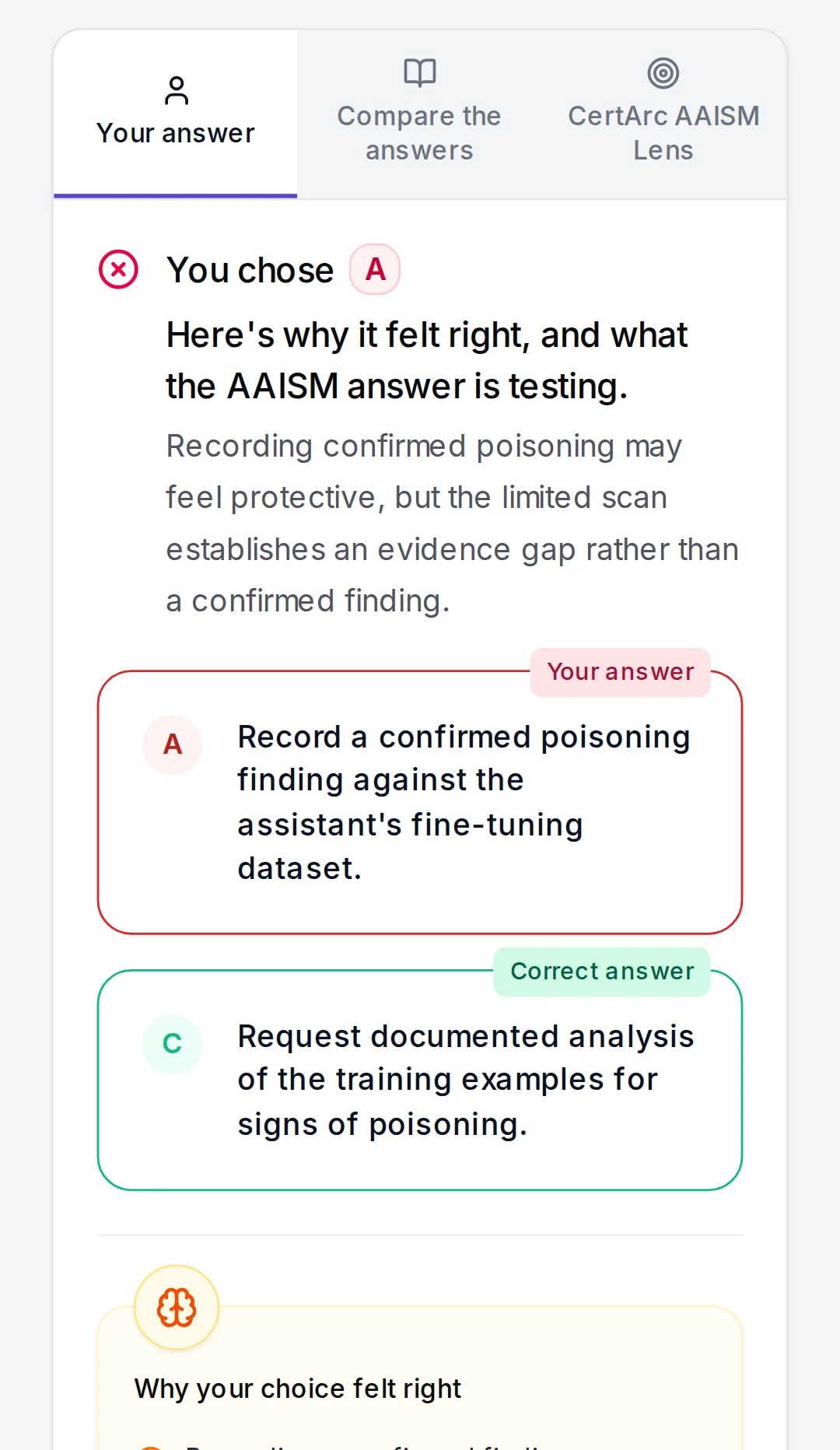
An insurer's claims-triage AI has passed its intended-use evaluation. Before wider release, the AI program manager finds that the operations team receiving it has no owners for live monitoring, human override, recovery or change escalation, and no communication path for those events. Which action should the manager take?
A. Proceed with wider release and have operations assign the missing ownership after the first live performance review.
- Why this may look right
- “Live experience can reveal practical operating needs and help refine responsibilities, so assigning ownership at the first review may appear efficient.”
- Where it breaks
- “The known gap exists before release, so waiting for live experience leaves monitoring, override, recovery, and escalation events without accountable recipients.”
B. Condition wider release on assigning receiving-team owners for monitoring, override, recovery, and change escalation, with a communication path.
- Correct answer. Why this wins
- “It resolves the stated readiness condition by assigning operational accountability and communication while respecting that intended-use evaluation has already succeeded.”
C. Extend the pilot and repeat intended-use evaluation before deciding who will own post-deployment operating responses.
- Why this may look right
- “More testing can appear to reduce deployment uncertainty, and extending the pilot may seem like a cautious way to gather further evidence before wider use.”
- Where it breaks
- “The evaluation has passed, and repeating it does not assign monitoring, override, recovery, or escalation responsibilities.”
D. Proceed with wider release and rely on the model vendor to own monitoring, overrides, recovery, and change escalation.
- Why this may look right
- “The vendor may possess specialized model knowledge and incident-response capability, making it appear naturally suited to own technical operating events.”
- Where it breaks
- “Vendor expertise can support operations, but reliance alone leaves receiving-team responsibilities and the required communication path undefined.”
Key takeaway: “When evaluation is complete but operational accountability is missing, close the accountability gap before approving wider use.”
Each wrong option here is a reasonable move at another point in an AI system's life: more testing when evidence is thin, vendor support for defined duties, live reviews to refine an operating model. The stem fixes which point this is: evaluation done, owners missing. For a CISM holder the manager's move is familiar; what AAISM adds is the AI lifecycle around it.
Where the 130 fall against ISACA's weights
Only candidates with an active CISM or CISSP can sit ISACA's AAISM exam: 90 multiple-choice questions in 2.5 hours, on ISACA's 200–800 scale, where 450 passes.
| Domain | Weight | About this many of the 90 | On this page | Free sprint |
|---|---|---|---|---|
| 1. AI Governance and Program Management | 31% | 28 | 3 | 25 |
| 2. AI Risk Management | 31% | 28 | 3 | 25 |
| 3. AI Technologies and Controls | 38% | 34 | 4 | 25 |
The counts are each weight times 90; ISACA publishes no per-domain count and includes unscored pretest items. ISACA's candidate guide calls Domain 2 "AI Risk and Opportunity Management" and its outline page "AI Risk Management": same domain, same weight. The baseline (25) and the practice exam (30) mix all three.
What changes after CISM or CISSP: AAISM is shorter (90 questions in 2.5 hours), and its largest domain, AI Technologies and Controls, is about controls built for AI systems: AI security architecture, the AI life cycle (model selection, training and validation), data management, privacy, ethics, trust and safety, and monitoring. AAISM vs CISM.
Who can sit it, and how the exam runs: AAISM eligibility and exam format.
ISACA's free AAISM questions and CertArc's
ISACA's free AAISM practice quiz has 12 questions; CertArc has 10 here and 130 with a free account.
| Source | Free | After the free part |
|---|---|---|
| ISACA free AAISM practice quiz | 12 questions | ISACA's AAISM QAE database: 200+ questions, sold as six months' access |
| CertArc | 10 here with no sign-in; 130 with a free account for 21 days, no card, each with the full review | Paid access |
Sites selling "AAISM dumps" or "real exam questions" fill much of Google's first page for this search. ISACA's AAISM candidate guide treats recreating or sharing exam content as prohibited conduct (page 13). For paid banks compared, see Best AAISM practice exams compared.
Using 130 free questions in 21 days
Five sessions in 21 days, about one every four days.
- Take the baseline, and rate every answer Confident, Unsure or Guess before the review opens.
- Do the sprint in the domain the app marks "Start with".
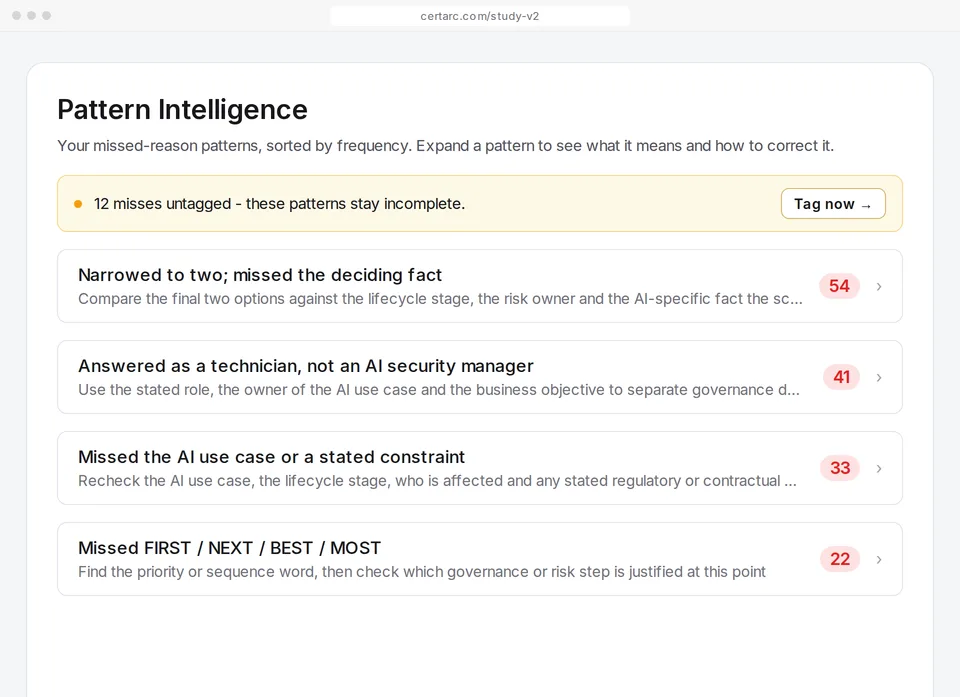
- Where a Confident answer came back Incorrect, read its "Why this may look right" first: it names the pull you followed.
- Do the other two sprints, AI Technologies and Controls first if it isn't done.
- End on the 30-question practice exam, mixed across all three domains.
Sources and fact check
Checked 13 November 2026. CertArc counts come from the live free path.