Your 130 free AAIA questions, session by session
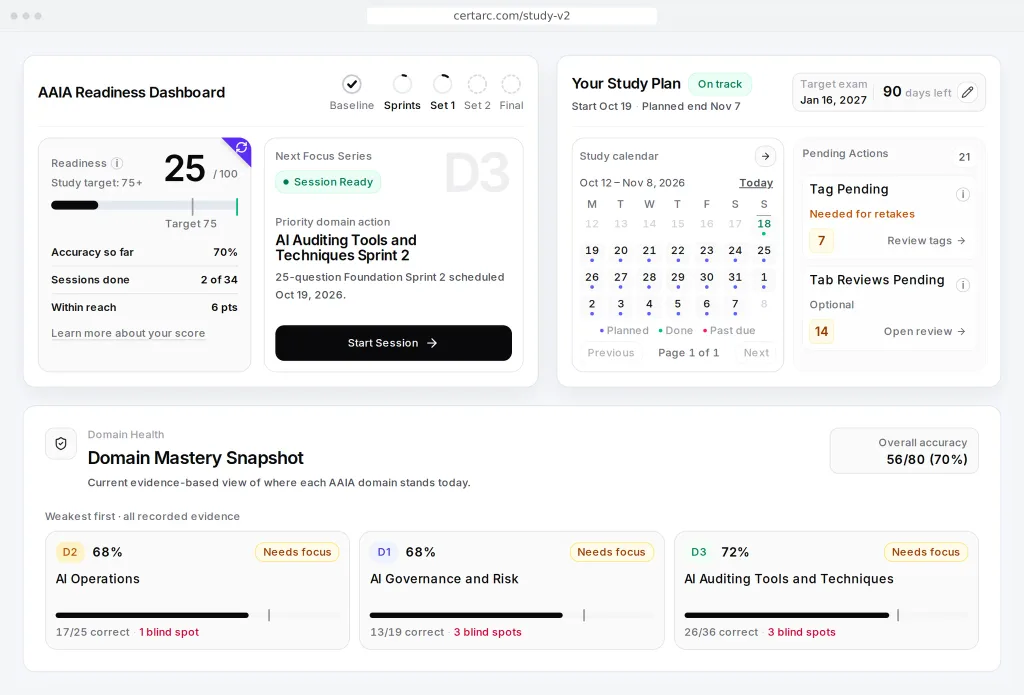
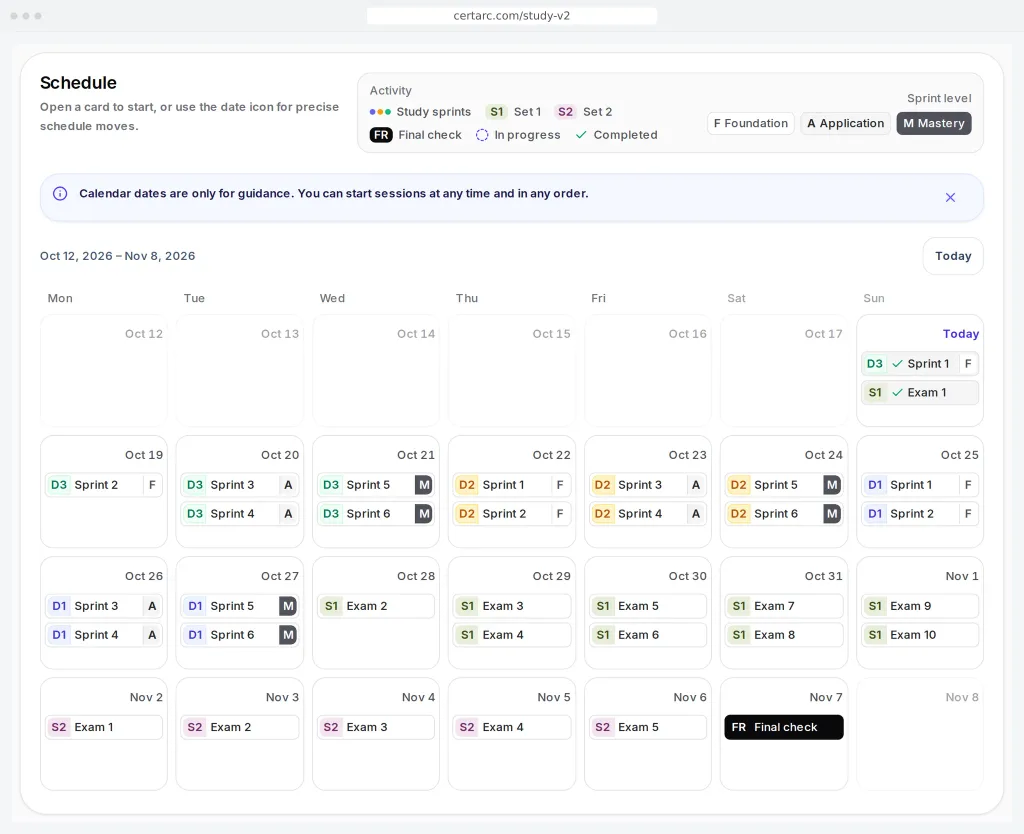
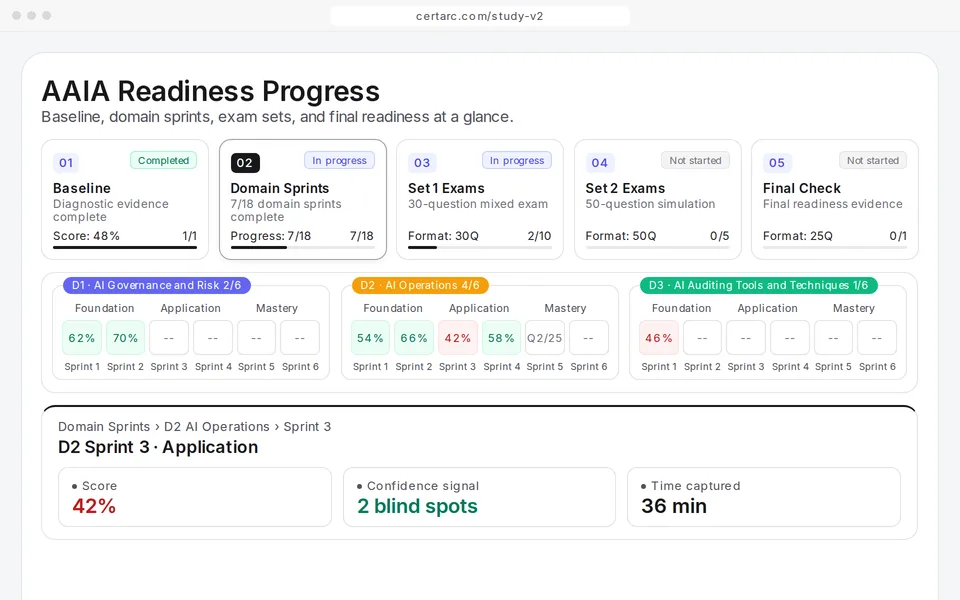
A free CertArc account opens 130 AAIA questions, each with the full review, which compares every option: a 25-question baseline, a 25-question sprint in each of the three domains and a 30-question practice exam, over 21 days with no card. The 10 questions above are a sample you can answer without signing in. ISACA's own free AAIA practice quiz has 12 questions.
| Free session | Questions | What it's for |
|---|---|---|
| Baseline | 25 | Your first readiness picture |
| Domain sprints | 75 (one 25-question sprint per domain) | Practising one domain at a time |
| Practice exam | 30 | The three domains mixed, as on the exam |
| All free questions | 130 | 21 days of free access, no card needed |
Answers to the 10 questions
Try them in the set above first.
Question 1 · AI Operations
Question 2 · AI Governance and Risk
A retailer's development lead prioritizes frequent forecast-model drift alerts over a recently retrained fraud model's wrongful declines of legitimate purchases. Forecast errors remain within approved tolerance; declines exceed tolerance for one customer group. Which risk-response ownership should the auditor validate first?
- A. Validate documented ownership of forecast drift remediation as the immediate priority.
- B. Validate the development lead's release approval as customer-risk acceptance authority.
- C. Validate risk-response ownership during the next scheduled fraud-model retraining review.
- D. Validate accountable ownership for the excessive customer rejection risk response.
- Correct answer: D. Why this wins
- Wrongful declines exceed tolerance for one customer group, while forecast errors remain within approved tolerance. Validating ownership of the customer-risk response therefore addresses the highest stated exposure without making the auditor responsible for fixing the model.
- Key takeaway
- Use the affected group's outcomes and tolerance status to prioritize accountability checks across competing AI risks.
- Exam trap
- Drift alerts warrant investigation, but their frequency does not establish greater impact. The stated forecast errors remain within tolerance, so their volume cannot settle priority.
Question 3 · AI Operations
For a consultancy’s document assistant, the security architect proposes relaxing prompt-injection filtering to reduce rejected legitimate client requests. Attack tests passed at the existing setting. The architect asks the auditor to tune the filter for release. What should the auditor do?
- A. Tune the filter under the architect’s supervision using regression tests covering malicious prompts alongside legitimate requests.
- B. Recommend adversarial-only regression testing of the proposed setting because this change concerns a security control.
- C. Escalate a recommendation for model-owner regression testing covering malicious prompts alongside legitimate client requests.
- D. Recommend postponing regression testing until monitored client usage reveals the relaxed filter’s effects on actual requests.
- Correct answer: C. Why this wins
- The only stated test success concerns attacks at the existing setting. Recommending model-owner regression tests at the proposed setting addresses injection resistance and client acceptance while preserving the auditor's evaluative role.
- Key takeaway
- For a guardrail change, match evidence to the proposed setting and both objectives while leaving operational tuning with its owner.
- Exam trap
- The supervised approach gets the test mix right. Its weakness is who adjusts the filter: the auditor would perform the operational work that the audit must evaluate.
Question 4 · AI Operations
During near-miss triage, an assessor reviews a hospital's generative assistant used by nurses during patient calls. It produced a confident medication instruction citing a current, approved protocol, but the cited passage supported a different instruction. Availability and response times remained within service targets. Which output-supervision control should the assessor recommend to best mitigate recurrence?
- A. Recommend automatic rejection of responses lacking links to the approved protocol library.
- B. Recommend clinician verification of medication instructions against source protocols before use.
- C. Recommend monthly clinical review of sampled responses from completed patient calls.
- D. Recommend escalation of alerts when latency exceeds the approved service threshold.
- Correct answer: B. Why this wins
- The cited passage supported a different instruction, so checking clinical meaning against the protocol targets the demonstrated failure. Doing so before use can prevent nurses from communicating unsupported guidance.
- Key takeaway
- For consequential clinical instructions, check that the source supports the instruction before relying on the generated response.
- Exam trap
- A missing-link filter checks whether an approved reference is linked. The reported defect is that the instruction differs from its cited passage, which requires a clinical meaning check.
Question 5 · AI Operations
In a lender’s AI data governance architecture review, an assessor finds training extracts reconcile completely to historical booked loans. The data owner cites these reconciliations as proof of suitability for scoring new loan applicants. What should the assessor do next?
- A. Accept the documented reconciliations as sufficient support for the training data’s suitability.
- B. Defer the concern until production monitoring provides evidence of unequal approval outcomes.
- C. Approve the selection criteria governing admission to the lender’s next training dataset.
- D. Escalate the unsupported claim that training data represent prospective loan applicants.
- Correct answer: D. Why this wins
- The extracts reconcile to booked loans, a population shaped by prior lending selection. Escalating the unsupported suitability claim addresses what the evidence cannot establish without assuming that biased outcomes have occurred.
- Key takeaway
- When the intended scoring population extends beyond the source population, assess the selection link before accepting suitability.
- Exam trap
- Reconciliation gives credible assurance about extraction from booked loans. Its strength on completeness does not answer whether those records represent prospective applicants.
Question 6 · AI Auditing Tools and Techniques
For a manufacturing AI lifecycle audit, the security leader presents validated defect-detection results for a centrally released model. Each factory retrains its deployed copy using local images. The approved audit scope covers the central release. Which audit action is most appropriate?
- A. Test defect-detection accuracy on a sample of locally retrained production models.
- B. Deploy the centrally validated model to replace the locally retrained copies.
- C. Escalate the model coverage concern to the audit engagement lead.
- D. Accept central validation as sufficient support for the planned lifecycle coverage.
- Correct answer: C. Why this wins
- Factories retrain their deployed copies, while the approved scope covers the central release. Escalation brings the resulting coverage concern into audit planning before substantive tests are selected.
- Key takeaway
- When deployed variants emerge beyond planned coverage, raise their relevance to the audit objective before selecting tests.
- Exam trap
- Local accuracy tests could be useful, but selecting them now skips the coverage decision. The issue is when to test the factory variants, not an assumption that those variants have poor accuracy.
Question 7 · AI Governance and Risk
An electricity utility's privacy officer proposes anonymization as sufficient protection for a planned AI model trained on historical outage responses to prioritize service restoration. Which control should the auditor recommend to evaluate the model's ethical impact on affected communities before deployment?
- A. Recommend a stakeholder impact assessment covering unequal restoration burdens across communities.
- B. Recommend a privacy impact assessment validating anonymization of historical household outage records.
- C. Recommend a performance acceptance threshold based on matching historical restoration priorities.
- D. Recommend an ethics review after affected communities submit documented restoration complaints.
- Correct answer: A. Why this wins
- The objective is to evaluate community impacts before deployment. A stakeholder impact assessment examines whether differing restoration burdens are justified in context while leaving restoration decisions with management.
- Key takeaway
- For a model that allocates services, evaluate who bears the burdens and whether the differences are justified in context.
- Exam trap
- Protecting household identities addresses a real concern. It does not show how the planned model distributes restoration burdens, so validating anonymization alone leaves the ethical question open.
Question 8 · AI Operations
A security architect seeks an operational exception for a public benefits fraud model susceptible to crafted-input evasion. Processing must continue; retraining takes three months, whereas manual screening meets service targets. What should the auditor recommend management authorize as the immediate response?
- A. Recommend adversarial retraining before releasing the next production model.
- B. Recommend temporary manual screening of submissions exposed to evasion.
- C. Recommend immediate deployment of a replacement model awaiting validation.
- D. Recommend accepting current exposure based on documented standard-input accuracy.
- Correct answer: B. Why this wins
- Processing must continue, and the stem explicitly says manual screening meets service targets. It provides an immediate alternative while retraining takes three months, with management authorizing the response.
- Key takeaway
- For an exposed operating period, recommend an available control that addresses the threat within the stated service constraints.
- Exam trap
- A recommendation about the next production release does not cover the three months before retraining finishes. Pair future model improvement with protection for the exposed operating period.
Question 9 · AI Auditing Tools and Techniques
During a professional-services architecture review, the security architect challenges an AI-drafted audit finding of actual client-data leakage. Two models agree, citing only a diagram of permitted flows. The report is due today. What should the auditor escalate to the audit manager?
- A. Escalate the models’ agreed finding as confirmed leakage requiring incident containment.
- B. Escalate the architect’s challenge for resolution through the architecture approval board.
- C. Escalate the finding’s evidence limitation as a concern affecting report release.
- D. Escalate the AI drafting weakness for discussion at the next quality review.
- Correct answer: C. Why this wins
- Only a diagram of permitted flows supports the actual-leakage claim, and the report is due today. The audit manager needs that evidence limitation now to assess report reliability before release.
- Key takeaway
- For an imminent audit report, escalate a material gap between a finding's wording and what its cited evidence establishes.
- Exam trap
- Two matching interpretations can strengthen confidence without strengthening support for the event. Trace both conclusions back to their source before treating agreement as corroboration.
Question 10 · AI Governance and Risk
After generative AI triage reduces routine workloads, a bank’s incident commander proposes reducing analyst headcount. Audit findings show experienced fraud analysts catch fabricated explanations in complex cases; routine-case automation meets approved risk tolerances. Which workforce-program design should the auditor recommend?
- A. Analyst retraining for mandatory human review across every alert category.
- B. Analyst reskilling for redeployment into complex-case AI oversight roles.
- C. Model-developer training as the primary response to analyst workforce impacts.
- D. Analyst retraining for customer-service redeployment of the fraud-review team.
- Correct answer: B. Why this wins
- Experienced fraud analysts catch fabricated explanations in complex cases, while routine automation meets approved risk tolerances. Reskilling connects displaced analyst capacity to the oversight need established by the audit.
- Key takeaway
- Recommend development for the judgment AI still needs from analysts, while management owns the resulting staffing decisions.
- Exam trap
- The routine-case finding limits that inference: automation there meets approved tolerances. Preserving human judgment calls for targeted oversight development, not mandatory review across all categories.
Worked example: which evidence settles the finding
Question 1's answer follows. The quoted text is the review as a CertArc learner sees it.
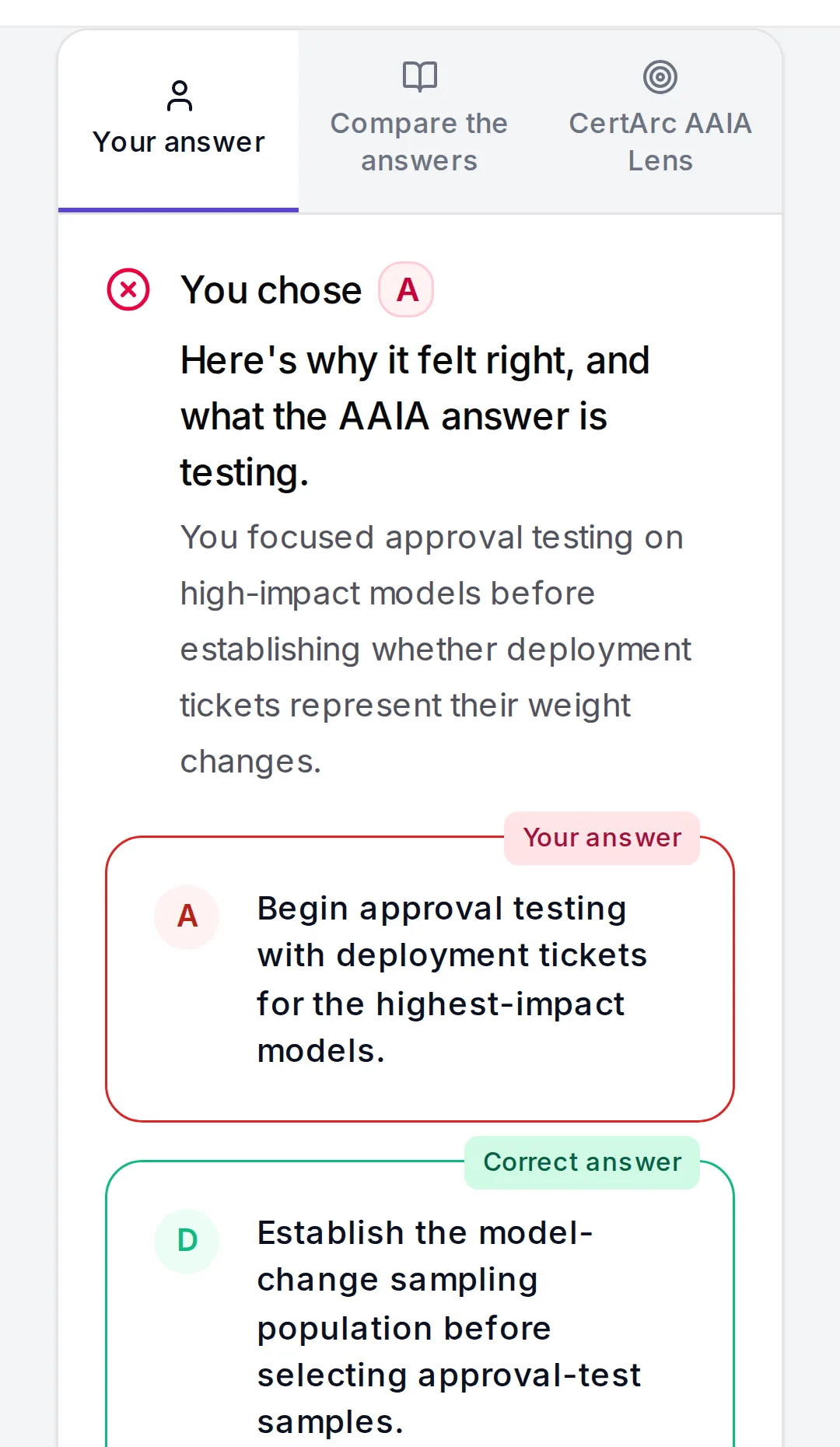
A factory's system owner disputes a change-control finding: defect-detection accuracy is still within approved limits and the model's code hasn't changed. Production logs show the model's weights are retrained every week. What should the auditor verify first?
A. Verify coverage of deployed retraining updates within the change-control process.
- Correct answer. Why this wins
- “Production logs establish weekly weight updates, so model changes occur despite unchanged code. Verifying coverage addresses the program question that acceptable accuracy leaves unresolved.”
B. Verify current accuracy as evidence of effective model-change control.
- Why this may look right
- “Acceptable accuracy makes the owner's challenge credible because it measures the factory system's stated task. Checking it is useful when the audit objective concerns model performance.”
- Where it breaks
- “Accuracy within approved limits does not show whether the weekly weight updates are included in change control. Performance evidence cannot settle this initial coverage question.”
C. Verify application code commits for evidence of approved production release reviews.
- Why this may look right
- “Release-review evidence offers a familiar way to investigate production changes. Code commits are relevant when the audit objective is to verify approvals for application code releases.”
- Where it breaks
- “The code is unchanged, while logs establish weekly changes to weights. Code commits alone do not establish whether change control includes these retraining updates.”
D. Verify next month's drift report for signs of retraining-related deterioration.
- Why this may look right
- “Monitoring can reveal changes worth investigating after deployment, making a future drift report seem useful. It fits an audit objective concerned with subsequent model behavior.”
- Where it breaks
- “The logs already establish weekly weight updates, so the auditor can check coverage now. Next month's drift report would not establish whether those updates entered change control.”
Key takeaway: “When retraining changes deployed weights, establish process coverage before evaluating how the applicable controls operate.”
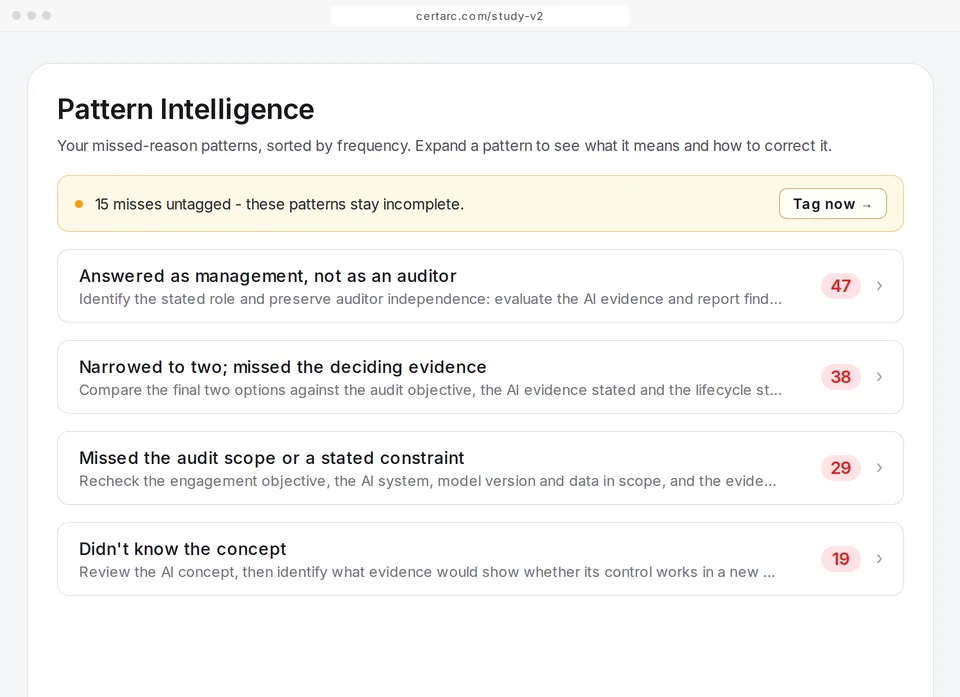
The pattern behind B, C and D recurs across AI audit questions: an outcome or an artefact (good accuracy, clean code reviews, a future report) is offered in place of evidence that the control covers the change that actually happened. When the auditee answers a finding with a result, go back to what the finding is about. The AI evidence trap.
Where the AAIA marks are
AAIA is 90 multiple-choice questions in 2.5 hours. ISACA scales the result to 200–800, and you need 450.
| Domain | Weight | On this page | Free sprint |
|---|---|---|---|
| 1. AI Governance and Risk | 33% | 3 | 25 |
| 2. AI Operations | 46% | 5 | 25 |
| 3. AI Auditing Tools and Techniques | 21% | 2 | 25 |
AI Operations is close to half the exam, and 5 of the 10 questions here come from it. Each domain gets one free 25-question sprint after a baseline that covers all three, so the AI Operations sprint is where to spend the most review time. The per-domain lines on ISACA's score report are informational: the pass is the number you got right across all 90, whatever the domain. The three AAIA domains.
Who can sit AAIA
An active CISA qualifies on its own.
ISACA also accepts these if you hold them in an IT audit or IT advisory role: CIA; US CPA; ACCA or FCCA; Australian CPA or FCPA; Japanese CPA; Canadian CPA; ICAEW ACA or FCA; Nigeria's CNA (ANAN); CA ANZ CA or FCA; Hong Kong CPA or FCPA. AAIA eligibility and exam format.
ISACA's free AAIA practice next to CertArc's
ISACA's free AAIA practice quiz has 12 questions; CertArc has 10 here and 130 with a free account.
| Source | Free | Beyond that |
|---|---|---|
| ISACA free AAIA practice quiz | 12 questions | The AAIA QAE database: 200+ questions, six months' access |
| CertArc | 10 on this page; with a free account, 130 over 21 days in five sessions, no card | Paid access |
Many results for this search sell AAIA "dumps". ISACA's AAIA candidate guide lists copying, memorising or recreating exam content, or helping anyone do so, as unacceptable behaviour. Paid AAIA banks are compared in Best AAIA practice exams compared.
Spending the 130 in 21 days
Five sessions, about one every four days.
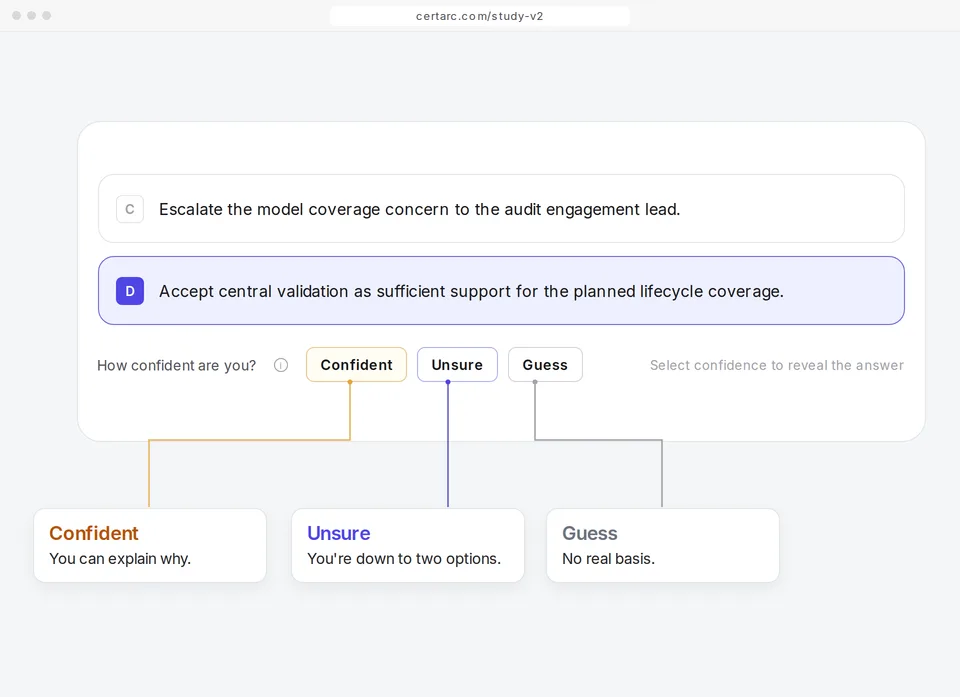
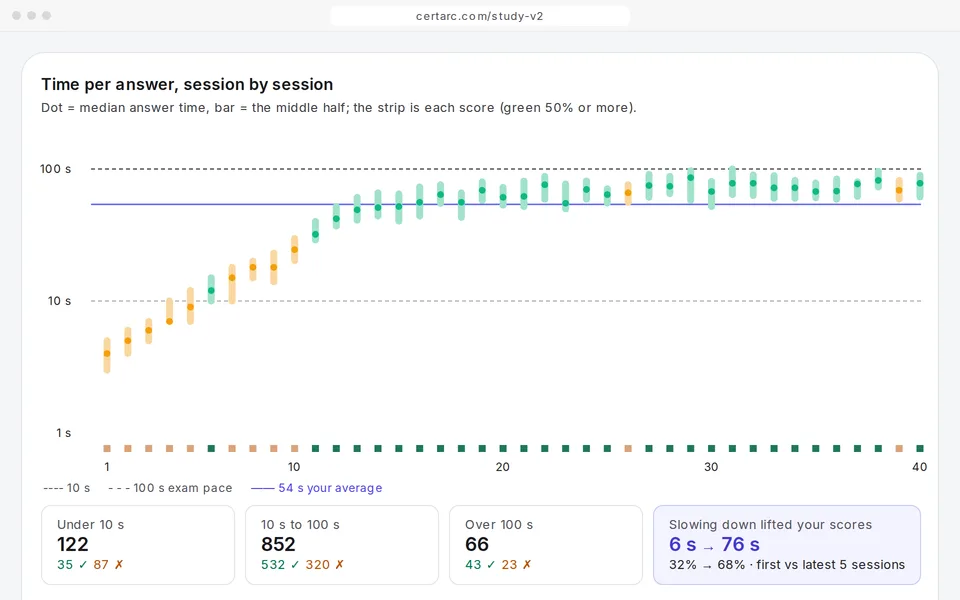
- Baseline first. Before each review opens, mark the answer Confident, Unsure or Guess.
- The sprint for the domain the results mark "Start with".
- The AI Operations sprint, if it wasn't the first.
- In "Compare the answers", read "Why this may look right" on each answer you were Confident about that came back Incorrect.
- The last domain's sprint, then the 30-question practice exam.
Sources and fact check
Checked 13 November 2026. CertArc counts come from the live free path.