Why do technical people fail CISM questions?
Executive Summary & Key Takeaway
If you keep missing CISM questions despite knowing the technology, check whether you are solving the visible technical problem before identifying the management decision.
According to ISACA, the CISM Exam Content Outline covers Information Security Governance, Information Security Risk Management, Information Security Program, and Incident Management. That structure explains why technical skill alone is not enough: the exam is testing management judgment across those domains.
One pattern to check is what this guide calls Technical-First Bias: seeing a real problem, choosing a technically useful action, and missing a cue about ownership, prioritization, escalation, or governance. This is a review aid, not a measured claim about why candidates fail.
Verified official source: ISACA CISM Exam Content Outline
CISM Answer Trap Translator
| Trap | Why it feels right | Stronger managerial lens |
|---|---|---|
| Technical-First Bias | The technical action is visible, fast, and often something you would do at work. | A CISM answer may first need risk ownership, business impact, escalation, policy, or process before technical execution. |
| Risk-Prioritization Gap | Several actions look useful, so the most active response feels safest. | The stronger answer ranks the response by risk, business objective, accountability, and timing. |
| Governance-Owner Confusion | Security professionals often feel responsible for solving the whole problem. | The stronger answer separates advice, execution, management accountability, and risk ownership. |
| Process-Order Trap | The action may be correct eventually, so it is tempting to choose it immediately. | The stronger answer chooses the right step for the current decision point, not merely a useful later step. |
What changes between a technical role and a CISM role?
In a technical role, success often means restoring service, closing a vulnerability, isolating a host, or configuring a control. In a CISM role, success means making the right management decision: who is accountable, what risk is being treated, what business objective is affected, and what process should govern the response.
That does not make the technical answer wrong in real life. It may simply be weaker for the question being asked.
How should technical candidates review misses?
For every miss, ask why the technical answer felt right. Then ask which management cue it skipped: risk owner, governance authority, business impact, communication, escalation, or sequence.
This review method helps convert practical experience into CISM answer strategy instead of asking candidates to ignore what they know.
How CertArc uses this
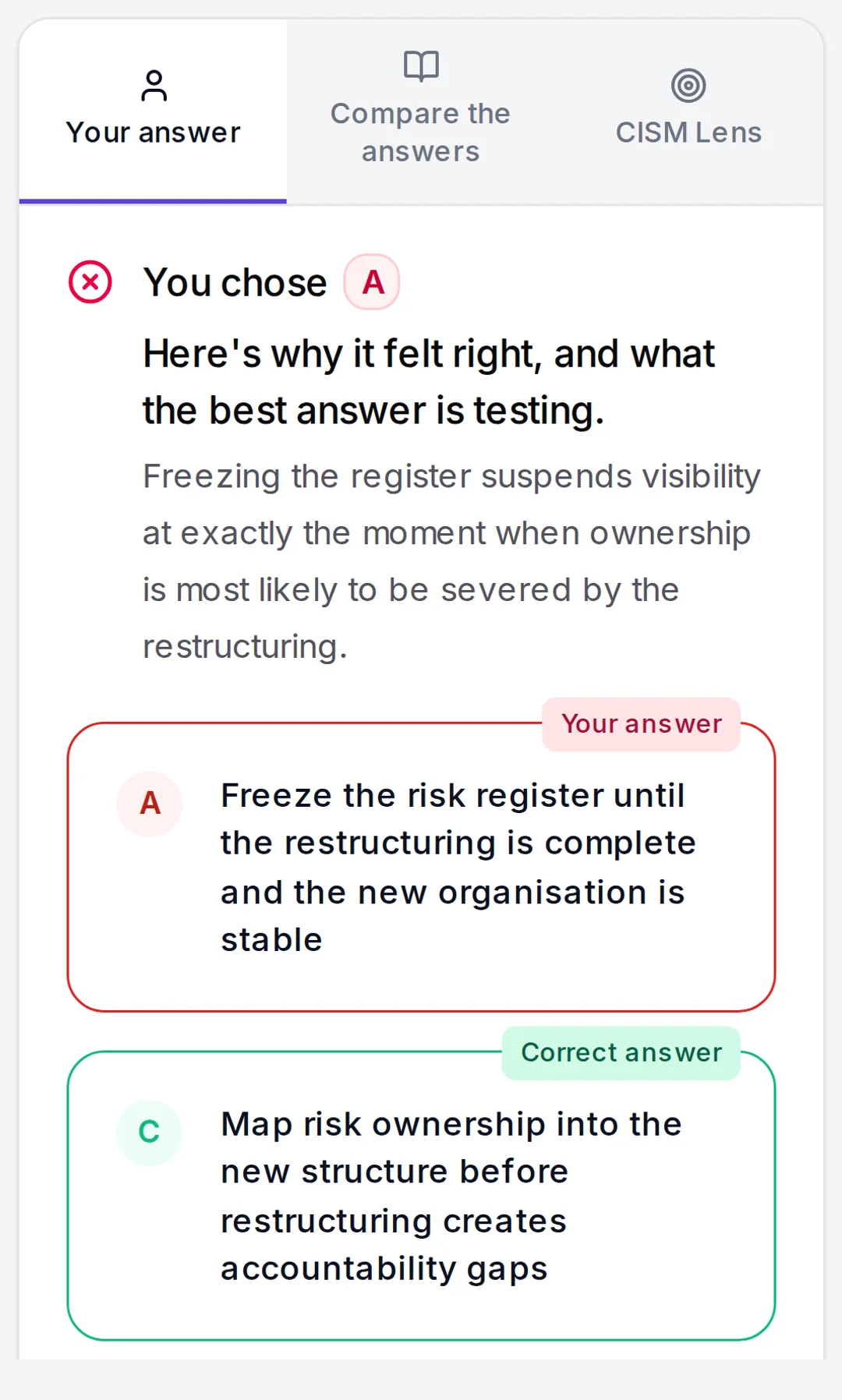
CertArc uses CISM Lens explanations to show why a tempting technical answer can be weaker than the managerial answer. As you review your answers, check whether the same Technical-First Bias pattern appears in more than one domain.
Why this distinction matters
This framework matters because it explains why technically strong candidates can miss CISM questions and names the reusable decision trap behind the pattern.
Common approaches that fall short
- Isolated definitions and individual practice questions do not always reveal the reusable decision trap behind a wrong answer.
- Copied or recalled item discussions cannot replace an original scenario pattern that teaches transferable judgment.
- Use the official domain context, trap translator, and named traps here to choose a stronger management response without relying on inside exam access.
Technical People Fail FAQ
Does CISM punish technical knowledge?
No. Technical knowledge helps, but CISM questions often ask for management judgment. The issue is usually role fit, timing, ownership, or risk priority, not lack of technical ability.
What is Technical-First Bias?
Technical-First Bias is the habit of choosing the fastest technical fix before checking whether the scenario requires governance, escalation, risk ownership, or business impact assessment.
How can CertArc help technical candidates?
CertArc uses original scenario practice, CISM Lens explanations, and diagnostic signals to help candidates see when the technical answer is tempting but managerially weaker.