Your 155 free CISM questions against the 2026 weights
ISACA's CISM exam is 150 multiple-choice questions in 4 hours, scored from 200 to 800 with 450 to pass, and since 3 November 2026 its four domains are weighted 18%, 20%, 33% and 29%.
| Domain | 2026 weight | On this page | Free sprint |
|---|---|---|---|
| 1. Information Security Governance | 18% | 2 | 25 |
| 2. Information Security Risk Management | 20% | 2 | 25 |
| 3. Information Security Program | 33% | 3 | 25 |
| 4. Incident Management | 29% | 3 | 25 |
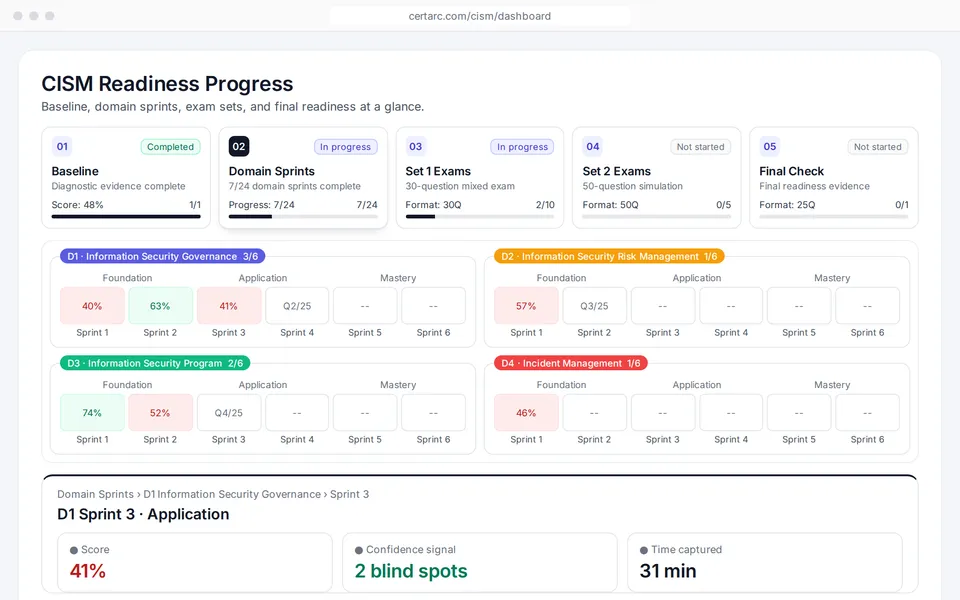
The 25-question baseline draws on all four domains. Two things about how ISACA scores the 150 that free banks rarely mention: every exam mixes in unscored pretest items, and the domain results on your score report are for information only. The pass decision rests on your total scaled score, so a low domain line doesn't fail you on its own and a high one doesn't carry you.
Answers to the 10 questions
Try them in the set above first.
Question 1 · Information Security Governance
Question 2 · Information Security Governance
An information security manager confirms that residual cyber risk on a recently launched digital sales channel now sits above the enterprise risk appetite endorsed by the board's risk committee last quarter. Engineering wants the channel to remain live to protect quarterly revenue commitments. What should the manager do FIRST?
- A. Direct engineering to suspend the channel until added controls bring residual risk inside the documented appetite.
- B. Escalate the breach to the risk committee with revise-appetite or require-treatment as the framed decision.
- C. Engage second-line risk to perform an independent reassessment before any escalation occurs.
- D. Update the risk register and table the breach at the next quarterly governance review.
- Correct answer: B. Why this wins
- It returns the decision to the body that endorsed the appetite, framed as a binary the committee can act on in one sitting.
- Key takeaway
- Manager value is framing the decision for the owner, not deciding for them.
- Exam trap
- Capable CISM candidates often pick the option that looks most action-oriented or most paper-trail-friendly. Suspending the channel reads as decisive, second-line reassessment reads as rigorous, and register-plus-quarterly reads as audit-ready. All three keep the decision inside the security function or push it to a calendar cycle, which is exactly where ISACA does not want it to sit when an appetite breach is on the table.
Question 3 · Information Security Risk Management
An organisation has identified a risk associated with an optional business process that carries significant potential impact but low inherent likelihood. The cost of implementing controls to reduce the risk to an acceptable level exceeds the business value generated by the process. Which risk treatment option is MOST appropriate?
- A. Accept the risk, as the low likelihood means the expected impact over time is manageable
- B. Transfer the risk through insurance to reduce the financial exposure to the organisation
- C. Mitigate the risk by implementing the most cost-effective controls available, even if they do not reduce risk to an acceptable level
- D. Avoid the exposure by stopping or not launching the nonessential activity
- Correct answer: D. Why this wins
- Names avoidance — eliminates exposure entirely when activity is optional and mitigation is uneconomic.
- Key takeaway
- When an activity is optional and the cost of achieving acceptable residual risk exceeds the business value it generates, avoidance eliminates the exposure and the ongoing cost simultaneously.
- Exam trap
- Three distractors each fail avoidance framing for optional+uneconomic. Accept-low-likelihood misses material impact. Insurance covers financial only. Partial-mitigation leaves residual.
Question 4 · Information Security Risk Management
Intelligence reports indicate a significant increase in state-sponsored cyber threat activity targeting the financial services sector. The organisation operates in this sector. The information security manager is evaluating whether to recommend changes to the organisation's risk posture. What should guide this evaluation?
- A. Wait for a direct attack against the organisation before adjusting the risk posture to avoid unnecessary expenditure
- B. Immediately increase security investment across all systems to match the perceived threat elevation
- C. Assess how the sector threat changes risk likelihood and whether controls or appetite need adjustment
- D. Notify the board that the threat environment has changed and request that they determine the appropriate response
- Correct answer: C. Why this wins
- It converts intelligence into a governed risk decision.
- Key takeaway
- When sector threat intelligence arrives, connect it to risk posture by assessing how it changes likelihood for the organisation's assets, then determine whether controls or appetite need adjustment.
- Exam trap
- CISM favours analysis that translates threat intelligence into a risk-based decision rather than either reactive extremes — waiting for proof or spending broadly — or passive escalation without analytical input. The governing principle is that intelligence becomes governance value when it is assessed against the organisation's specific risk profile and used to inform targeted recommendations on controls and appetite.
Question 5 · Information Security Program
Two organisations with different data classification schemes are entering a data-sharing partnership. Data classified as "Confidential" under one scheme maps inconsistently to the equivalent tier in the partner's scheme, creating confusion about required handling. The information security manager's MOST appropriate recommendation is to:
- A. Adopt the partner organisation's classification scheme as the standard for shared data
- B. Apply the more restrictive of the two classifications to all shared data to ensure maximum protection
- C. Define agreed handling standards for shared data in the data-sharing agreement
- D. Reclassify all data to be shared using a neutral third-party classification framework
- Correct answer: C. Why this wins
- The data-sharing agreement governs shared data at the boundary; it can define access, labelling, incident obligations, and retention for the shared dataset without touching either party's internal classification policy.
- Key takeaway
- When schemes do not translate across a boundary, the data-sharing agreement is the instrument — it defines handling without requiring either organisation to restructure its internal policy.
- Exam trap
- Three distractors miss the governance instrument. Adopting the partner's scheme imposes a foreign classification structure on your organisation without organisational authority. Applying the more restrictive tier consistently provides protection but does not resolve the handling ambiguity — two organisations with different procedures for their top tier still have a gap. Bringing in a third-party framework adds overhead and still requires a shared agreement to enforce handling; it does not eliminate the need for one.
Question 6 · Information Security Program
A newly appointed information security manager inherits a security awareness program reporting 100 percent completion, post-module assessment averages above 90 percent, and high learner satisfaction. The board has asked the manager to demonstrate that the program is actually reducing organizational risk. Which addition to the program metrics would most credibly support that claim?
- A. Track simulated-phishing click rate, user-reported phishing rate, and user-caused incident count against a stable baseline.
- B. Benchmark current completion rates and post-module assessment scores against peer organizations of comparable size.
- C. Mandate quarterly refresher modules and require line-manager attestation for any staff missing completion deadlines.
- D. Expand the curriculum with advanced threat scenarios and require pre and post assessments for each new module.
- Correct answer: A. Why this wins
- Awareness programs target user behavior, so the only credible test is whether the targeted behavior is moving in the right direction and whether incidents from that behavior are dropping.
- Key takeaway
- Always pair a behavior proxy with an incident outcome when asked to evidence program impact.
- Exam trap
- Distractors here borrow the vocabulary of accountability and rigor: mandate refreshers, attest non-completers, benchmark peers, instrument with pre and post assessments. Each leaves the underlying metric class unchanged. If the metric does not move when behavior moves, it is not measuring the program's purpose.
Question 7 · Information Security Program
An organisation uses a significant number of contractors who access internal systems as part of their work. The information security manager is reviewing whether the security programme adequately covers contractor access and behaviour. What is the MOST important consideration?
- A. Contractors should be required to meet the same security requirements as employees when they access the organisation's information and systems
- B. Contractors are covered by their own employer's security programme and do not need to be included in the organisation's programme
- C. Contractor security requirements should be limited to what is specified in the contract, as this defines the legal obligation
- D. Contractors should use separate systems from employees so that their activities do not affect the organisation's security posture
- Correct answer: A. Why this wins
- Names same-access-same-requirements — contractors with organisation access must meet employee security requirements to protect organisation consistently.
- Key takeaway
- Contractor organisation access → same requirements.
- Exam trap
- Three distractors each fail the same-access principle. Employer-covers relies on different programmes. Contract-limits restricts to legal floor. Segregate-systems is operationally infeasible.
Question 8 · Incident Management
During an investigation of a sophisticated breach, the security team discovers evidence suggesting that an attacker has compromised credentials of multiple members of the incident response team and may have been monitoring the team's response activities. What governance action should the information security manager take FIRST?
- A. Continue the investigation using existing team members while implementing additional monitoring of their activities
- B. Immediately notify all incident response team members that their credentials may be compromised and require password resets
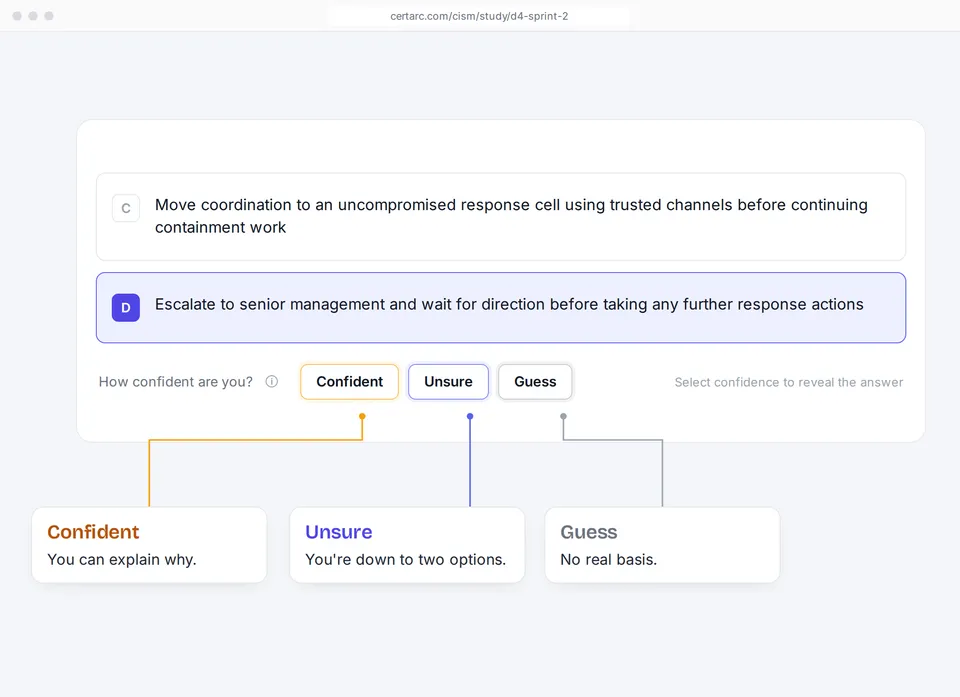
- C. Move coordination to an uncompromised response cell using trusted channels before continuing containment work
- D. Escalate to senior management and wait for direction before taking any further response actions
- Correct answer: C. Why this wins
- It restores a clean coordination channel before any further response — the governance precondition when responders themselves may be compromised and watched.
- Key takeaway
- Compromised responders + watched comms → clean channel first, then containment.
- Exam trap
- Three distractors keep the response on the watched channel: continue with extra monitoring of suspect team members, mass-notify everyone on the same comms, or escalate to senior management and wait. Each either tips the attacker that they've been seen, or stalls containment while the adversary keeps moving. None of them re-establish a trusted coordination path before the next response step.
Question 9 · Incident Management
An organisation's legal counsel advises that a security incident involving customer data may result in litigation or regulatory enforcement, and that a legal hold is required. The information security manager is asked to implement the legal hold. What does the legal hold PRIMARILY require from the incident response perspective?
- A. Immediately destroying all evidence of the security incident to protect the organisation from liability before litigation commences
- B. Suspending normal deletion schedules for incident-related materials until the legal hold is lifted
- C. Providing all incident evidence directly to the regulatory authority before any legal proceedings begin, to demonstrate the organisation's cooperation
- D. Encrypting all incident documentation and restricting access to the legal team only, to protect the evidence from discovery in potential proceedings
- Correct answer: B. Why this wins
- Names suspend-normal-deletion preservation — the primary legal-hold function for incident materials until counsel lifts.
- Key takeaway
- Legal hold → preservation via deletion suspension.
- Exam trap
- Three distractors each fail preservation framing. Destroy is obstruction. Regulator-disclose is premature. Encrypt-restrict misreads hold as access control.
Question 10 · Incident Management
A finance department workstation has just been confirmed infected with a banking trojan. The CFO is pressing IT to return the machine to service before end of day so invoice processing can resume. The information security manager has authority to direct the response. What should the security manager do FIRST?
- A. Isolate the workstation from the network and capture a forensic image following the incident response procedure before any rebuild.
- B. Reimage the workstation immediately so finance can resume invoice processing, then capture observations in the after-action report.
- C. Escalate the decision to the CFO so business leadership chooses whether evidence preservation or service restoration takes priority.
- D. Run the endpoint anti-malware utility to clean the trojan in place so the machine returns to service before end of day.
- Correct answer: A. Why this wins
- Follows the IR procedure the ISM is authorized to enforce — isolation stops trojan network activity, forensic imaging preserves evidence of scope and exfiltration before the workstation is rebuilt.
- Key takeaway
- ISM has response authority → follow IR procedure. Isolate + image before rebuild. CFO urgency is a stakeholder input, not an authority override.
- Exam trap
- B (reimage now) destroys the forensic image the IR procedure requires. C (escalate to CFO) abdicates the response authority the ISM already holds. D (AV in-place) may not fully remediate a banking trojan and bypasses the forensic preservation step.
Worked example: question 1 as the review explains it
Answer question 1 above first; this section gives the answer. The quoted lines are the review's own text, as learners see it.
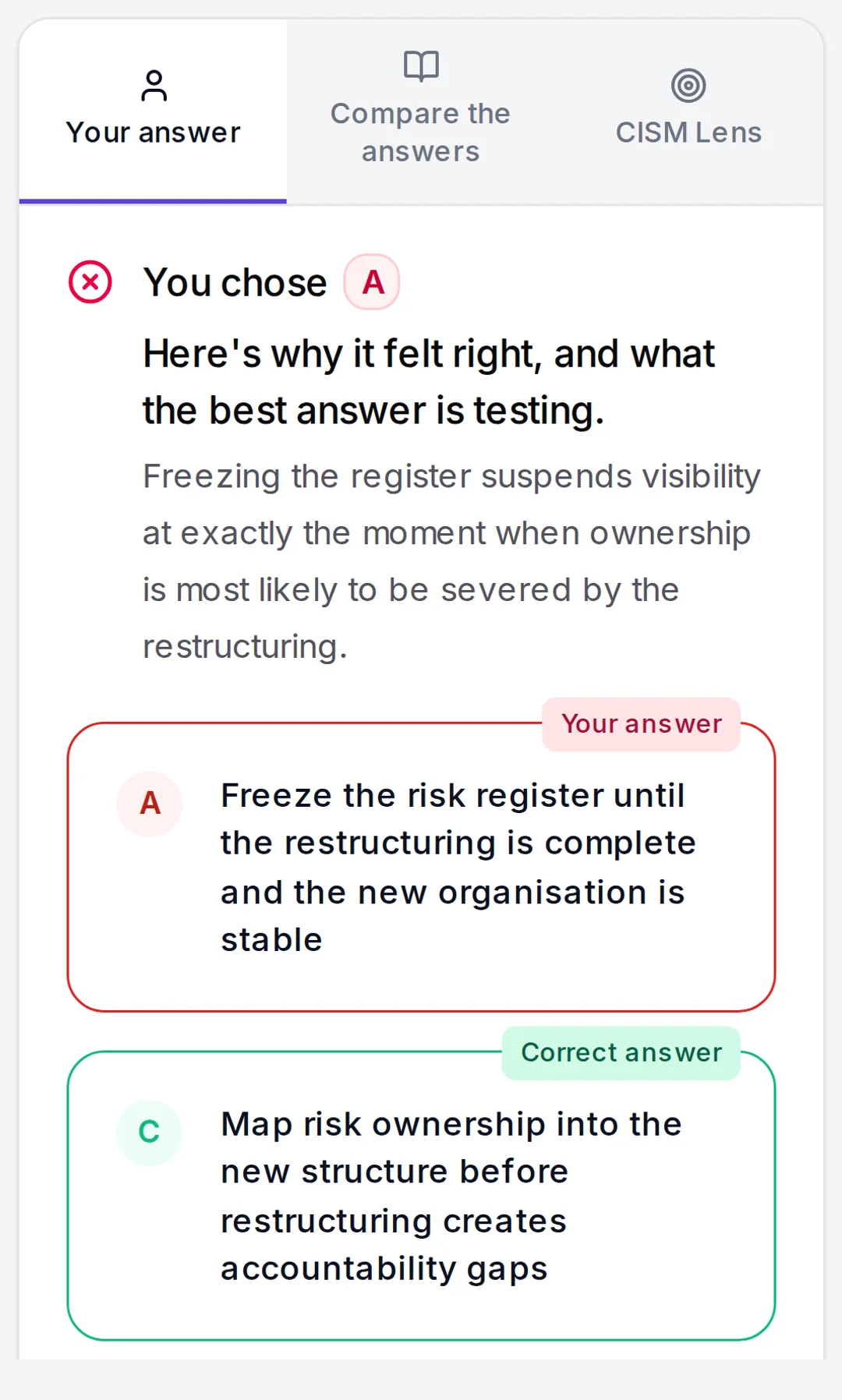
The scenario: compliance has started directing security controls from regulatory requirements, the two functions now overlap, and business units get conflicting directives. The question asks for the MOST appropriate way to resolve it.
A. Subordinate the information security governance programme to the compliance function since regulatory requirements take priority
- Why this may look right
- “Regulatory requirements feel non-negotiable and seem to justify compliance primacy.”
- Where it breaks
- “Subordinating InfoSec to compliance picks a winner without senior-management sanction — pre-empts the unresolved authority decision.”
B. Escalate to senior management to define the authority and boundaries of each function and establish a clear governance structure
- Correct answer. Why this wins
- “It escalates to the governance layer that owns the authority decision and establishes the structure that resolves conflicting directives at the source.”
C. Have the information security programme focus on risk management while the compliance function handles regulatory requirements independently
- Why this may look right
- “A clean risk-vs-regulation split sounds efficient and avoids picking a winner.”
- Where it breaks
- “Splitting scope assumes the boundary is agreed — but the stem says it isn't, and scope splits are downstream of authority.”
D. Merge the compliance and information security functions under a single governance authority to eliminate the overlap
- Why this may look right
- “Merging two overlapping functions feels like a clean way to eliminate the overlap.”
- Where it breaks
- “Merging restructures the org chart before authority has been defined — a major structural move that itself requires senior-management sanction.”
Key takeaway: “Cross-function authority gaps are resolved at the governance layer above both functions.”
Read across the wrong options and A, C and D fail the same way: each redraws the boundary before anyone with the authority to draw it has decided. That is the pattern to carry into the next governance-conflict question: a dispute over scope goes to whoever sets the scope. When two CISM answers look right.
Free and official CISM practice, side by side
ISACA gives 10 free CISM questions and sells a larger bank; CertArc gives 10 here and 155 with a free account.
| Source | Free | Explanations | Beyond the free part |
|---|---|---|---|
| ISACA free CISM practice quiz | 10 questions from ISACA's own test prep; results after you submit a form | Not stated by ISACA | ISACA's CISM QAE database: a six-month subscription to 1,047 questions |
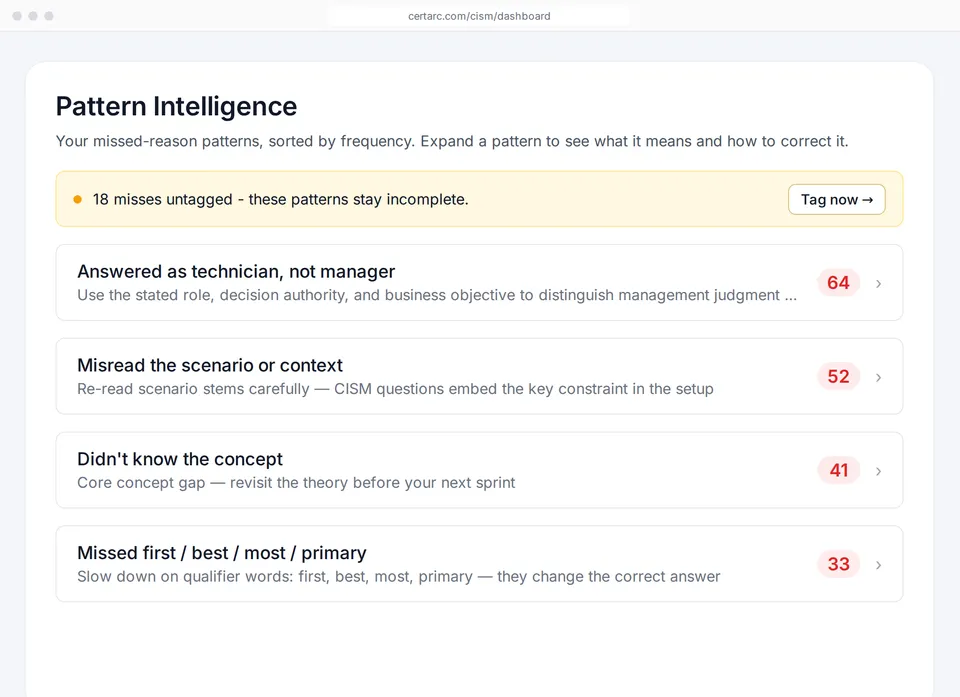
| CertArc | 10 on this page with no sign-in; 155 with a free account for 21 days, no card | The review on every answer; with free access, every option compared and the CertArc CISM Lens | Paid access |
Pages offering "actual", leaked or recalled CISM exam questions are a different thing. ISACA's Candidate Guide lists recreating, sharing or discussing exam content as prohibited conduct (pages 13–14). For paid banks by size, price and review, see Best CISM practice exams compared.
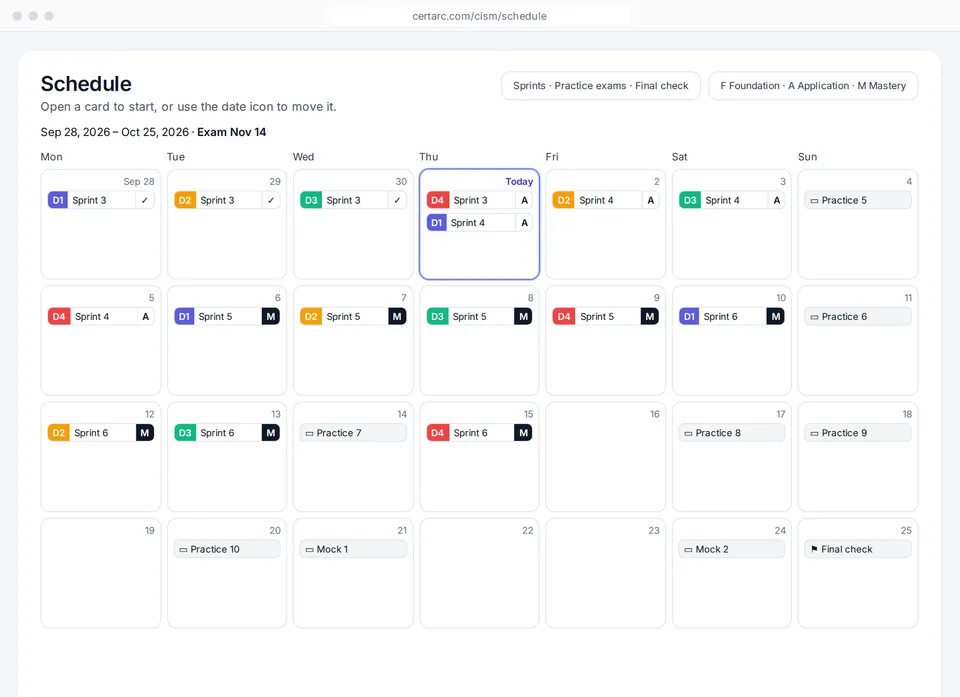
How to use 155 free questions in 21 days
Six sessions in 21 days: about one every three or four days.
- Take the 25-question baseline first, and mark each answer Confident, Unsure or Guess before you see the review.
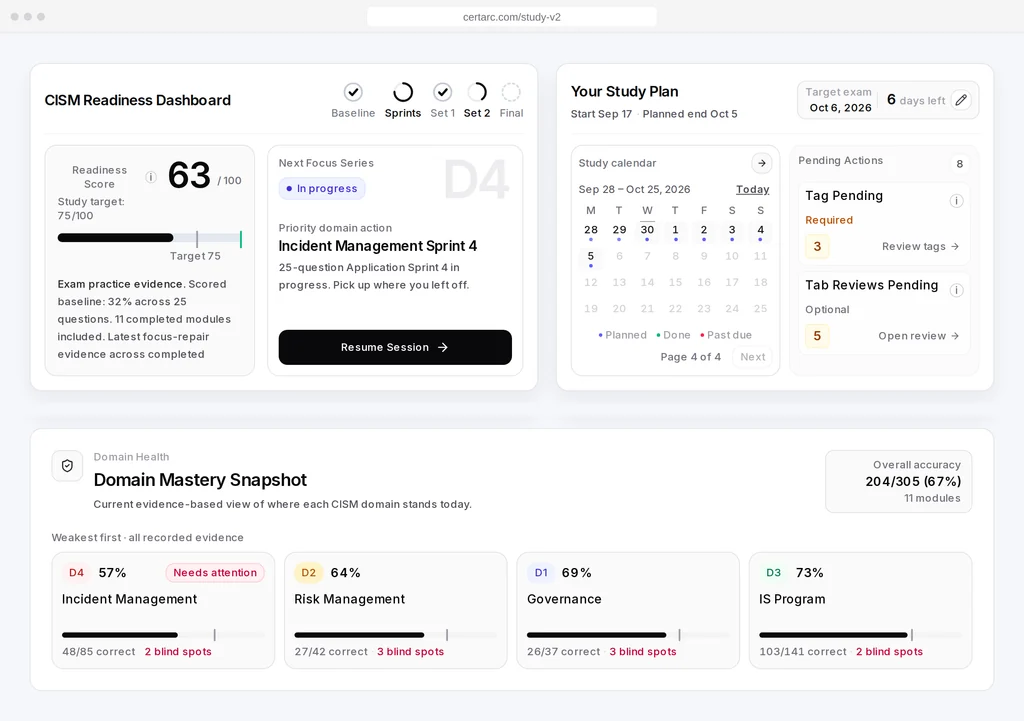
- Do the sprint for the domain the app marks "Start with".
- Review Confident answers that came back Incorrect before anything else: that is the reasoning you'd repeat on exam day without noticing.
- Do the Information Security Program and Incident Management sprints next if they aren't done yet: together they are 62% of the exam.
- Finish with the 30-question practice exam, a mixed-domain check after all four sprints.
If your questions came from the 2022 outline
ISACA's updated exam adds enterprise architecture and information security architecture, with greater emphasis on strategy and program development.
Sets written for the 2022 outline still show Information Security Governance at 17% and Incident Management at 30%, so check a source's weights before trusting its domain mix. What changed in the 2026 CISM exam.
Sources and fact check
Checked 13 November 2026. CertArc counts come from the live free path.