Last updated:
Free CISM Diagnostic: Find Your Study Focus
A free 25-question CISM diagnostic can show where your study needs attention first. It gives an initial snapshot: your score by domain, your weakest domain, your blind spots (Confident and wrong) and, once you tag why you missed, the reasons ranked in Pattern Intelligence. It does not determine exam readiness. Readiness requires repeated evidence from review, domain practice, and practice exams over time.
CertArc is built for candidates who understand many security concepts but still get stuck between two plausible answers. The diagnostic shows your weakest domain and your blind spots and, once you tag why you missed, whether the same reason keeps recurring.
Use the result to focus the next study block instead of reviewing every topic equally. As you continue with domain sprints, answer review, and practice exams, CertArc can add stronger evidence to your study plan and show how progress changes over time.
Find out which CISM domain is weakest, which answers were blind spots, and why you missed each question.
Takes about 10-15 minutes | Original scenario questions
You will get: Initial domain signals | Mistake pattern | Confidence signal | What to practice next
From diagnostic to continued practice
What happens after the 25-question diagnostic?
The diagnostic is the starting point, not a full readiness check. It gives you initial evidence about where to focus and why you missed. Continued review, domain practice, and practice exams build the broader progress and readiness view over time.
Diagnose
Capture your starting point
The assessment summary shows your score, review load, confident-wrong answers, and the first domain that needs attention. This is a starting snapshot, not a readiness verdict.
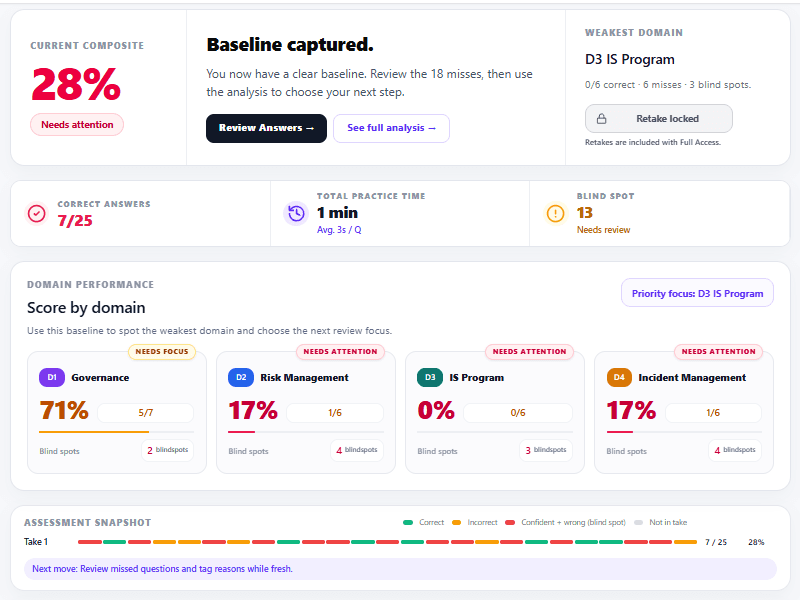
The starting snapshot connects the score to the first review priority. Review
Understand why every answer wins or loses
Open a missed question to compare all four choices. Result, confidence, and missed-reason filters narrow the review to blind spots, while the explanation shows why the managerial answer is stronger.
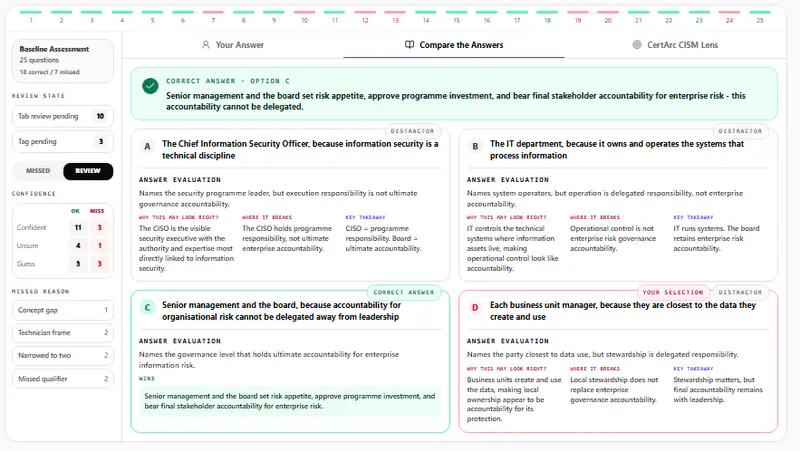
Compare every option, then record why the tempting answer felt right. Focus
Turn misses into a focused study plan
The analysis groups evidence by CISM domain and knowledge area, recurring miss pattern, confidence calibration, and pace. Those signals show whether the next study block should repair a concept, a decision pattern, or a timing problem.
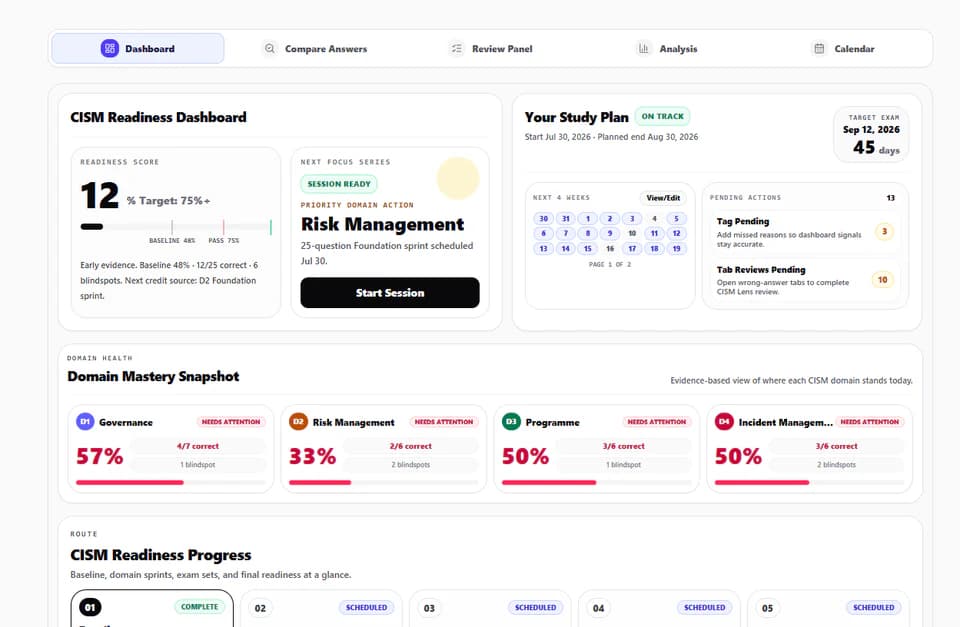
The dashboard turns the diagnostic evidence into a visible next focus. Practise
Practise and track progress over time
The calendar is part of the broader CertArc practice experience. Continued review, domain sprints, and practice exams add evidence over time, while the calendar helps sequence the work after a learner sets an exam date.
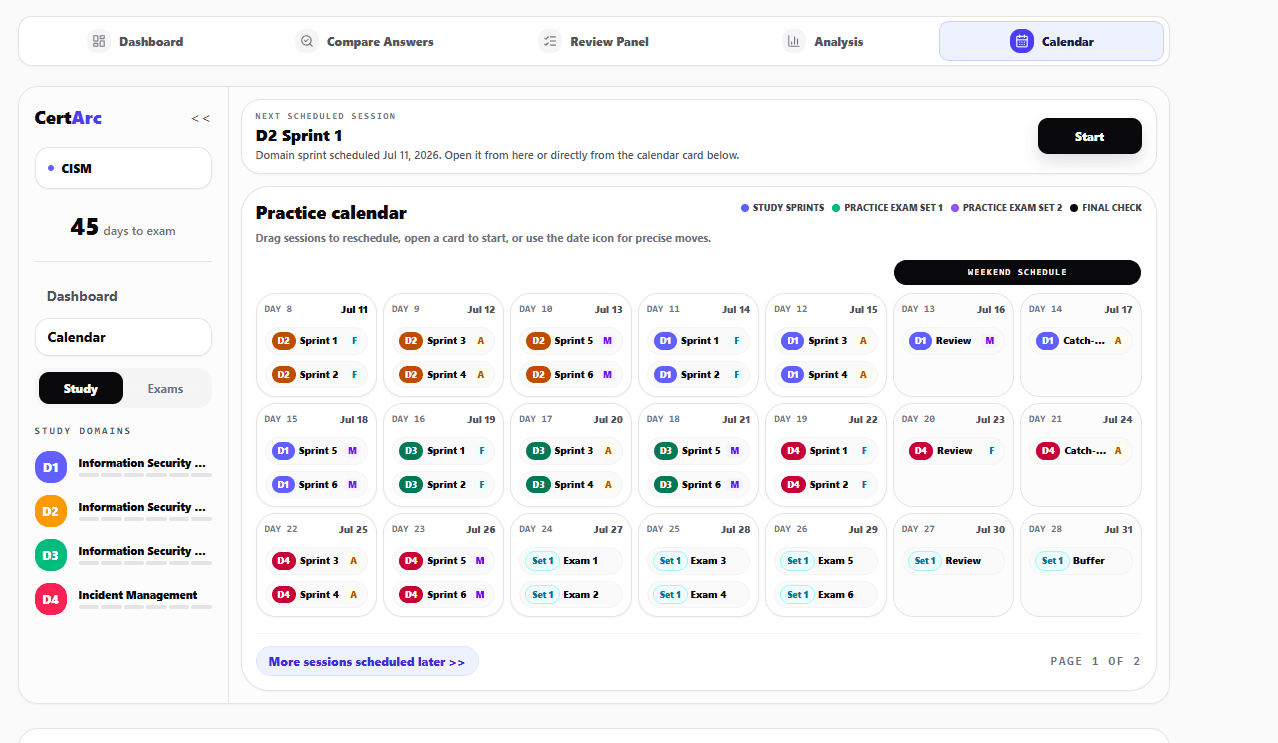
The calendar places focused sessions against the learner’s exam date.
Is a free CISM diagnostic the same as free CISM practice?
No. The diagnostic is one 25-question starting assessment. It helps identify the first likely domain, confidence, or decision-pattern focus. The wider free path adds four domain Foundation Sprints and one Practice Exam for eligible learners, so you can apply what you reviewed and gather stronger evidence over time.
Choose the diagnostic when you do not know where to begin. Choose continued practice when your starting focus is clear and you need unfamiliar scenarios, explanations, and repeated evidence. Neither one result nor one score predicts an official exam outcome.
This diagnostic is useful if
- ✓ your CISM exam is in the next 30-90 days
- ✓ you use ISACA QAE but still feel unsure
- ✓ you often narrow answers down to two choices
- ✓ you failed CISM once and need a clearer recovery plan
- ✓ you are moving from technical security into management
This diagnostic is not for
This diagnostic is not for candidates looking for actual exam questions, brain dumps, or guaranteed pass predictions.
What does the CISM diagnostic measure?
According to ISACA's current CISM Exam Content Outline, the exam covers four job-practice domains. CertArc uses original scenario practice to expose whether your errors are domain-specific or reasoning-specific.
| In your results | What it reveals | How CertArc uses this |
|---|---|---|
| Weakest domain | You are missing the concepts or scope inside one of the four CISM domains. | Your results show a score for each domain and name your weakest domain. |
| Answered as technician, not manager | You choose the answer that fixes the visible technical issue, or give the decision to the wrong role, before checking governance, risk ownership, escalation or business impact. | After a miss, the CertArc CISM Lens shows the scenario signal, the exam trap and the winning move. Tag the miss with this reason and Pattern Intelligence counts how often it recurs. |
| Narrowed to two, picked wrong | You recognize the security issue but do not consistently rank the response by risk, business objective, or accountability. | Compare the answers puts your choice beside the correct answer and shows where each one breaks. Tag the miss and Pattern Intelligence ranks it with your other reasons. |
| Blind spot | You were Confident and wrong: the score looks acceptable, but the reasoning is not stable yet. | You rate each answer Confident, Unsure or Guess. Your results count blind spots, and Confidence Calibration checks whether your confidence matches your accuracy. |
Why can a good practice score still feel uncertain?
One result can hide the quality of your reasoning. If you are right because you recognize wording, guess well, or repeat questions you have already seen, the percentage may overstate what you understand. CertArc asks how sure you are of each answer and counts confident wrong answers as blind spots, so you can review the mistakes you were sure of first.
Why the wrong answer can feel right
In CertArc you tag each miss with the reason the wrong answer felt right: “Answered as technician, not manager”, “Narrowed to two, picked wrong”, “Missed first / best / most / primary”, “Misread the scenario or context”, “Didn't know the concept” or “Changed from my first answer”. Pattern Intelligence then ranks your reasons, so you stop reviewing every miss the same way.
One question, reviewed the way CertArc reviews it
This is one of the 10 real CertArc questions in the public CISM preview. Pick an answer before you open the review.
An information security manager confirms that residual cyber risk on a recently launched digital sales channel now sits above the enterprise risk appetite endorsed by the board's risk committee last quarter. Engineering wants the channel to remain live to protect quarterly revenue commitments. What should the manager do FIRST?
- A.Direct engineering to suspend the channel until added controls bring residual risk inside the documented appetite.
- B.Escalate the breach to the risk committee with revise-appetite or require-treatment as the framed decision.
- C.Engage second-line risk to perform an independent reassessment before any escalation occurs.
- D.Update the risk register and table the breach at the next quarterly governance review.
See the review for each answer
Correct answer: B
The risk committee endorsed this appetite, so the committee owns the decision when residual risk crosses it. Framing the choice as revise-appetite or require-treatment lets governance act on a clean decision rather than an open question.
If you picked A
Why your choice felt right
CISM students often associate breach with stop-the-bleeding action by the security function.
Why it doesn’t hold here
At the authority boundary, because stopping a live channel exceeds the manager's mandate even when the breach is real.
If you picked C
Why your choice felt right
Students conflate three-lines-of-defense rigor with a gating step that must happen before any confirmed breach is escalated.
Why it doesn’t hold here
On timing, because reassessment delays the decision the appetite owner already needs to make on the live channel.
If you picked D
Why your choice felt right
Students see register entries plus scheduled review as the disciplined, audit-ready move.
Why it doesn’t hold here
On urgency, because deferring a live breach to the next cycle leaves the channel exposed and the owner uninformed.
In CertArc, the closest reason to tag for Option A is “Answered as technician, not manager”: the right concern, decided by the wrong role.
How CertArc uses this after the diagnostic
CertArc uses the starting snapshot to suggest a first practice path: domain work for likely knowledge gaps, CISM Lens explanations for reasoning traps, and scenario practice for weak patterns. Later sessions refine that path as more evidence becomes available. The goal is to understand why the stronger managerial answer wins, then test that reasoning again in new scenarios.
Free CISM diagnostic FAQ
What is included after the free CISM diagnostic?
After the 25-question multi-domain Baseline Assessment, eligible learners can activate 21-Day Free Access for four 25-question Foundation Sprints, one per CISM domain, and one 30-question Practice Exam. No credit card is required.
Does the diagnostic predict my exam score?
No. One 25-question assessment is an initial snapshot, not an exam prediction or a readiness verdict. It helps you decide what to study next; continued review, domain practice and practice exams build the wider readiness view over time.
Does CertArc use actual CISM exam questions?
No. CertArc uses original scenario-based practice and exam-aligned reasoning. It does not provide brain dumps or actual exam items.
How is this different from taking another practice quiz?
A normal quiz tells you what you missed. In CertArc you also tag why you missed it, for example “Answered as technician, not manager”, and Pattern Intelligence ranks your reasons.
Can I use the diagnostic if I already use ISACA QAE?
Yes. Official resources can help with familiarity and coverage. CertArc is designed to add mistake-pattern diagnosis and CISM Lens explanations.
What happens after the diagnostic?
You receive a practical study-focus view: which domains may need attention, which reasoning traps are showing up, and what to practise next. Continued work in CertArc then adds evidence to the wider progress and readiness views.
Find your CISM starting point
Use one 25-question diagnostic to identify likely focus areas, then refine the study plan through continued practice.
Start free diagnosticTakes about 10-15 minutes | Original questions
