Your 180 free CISA questions, session by session
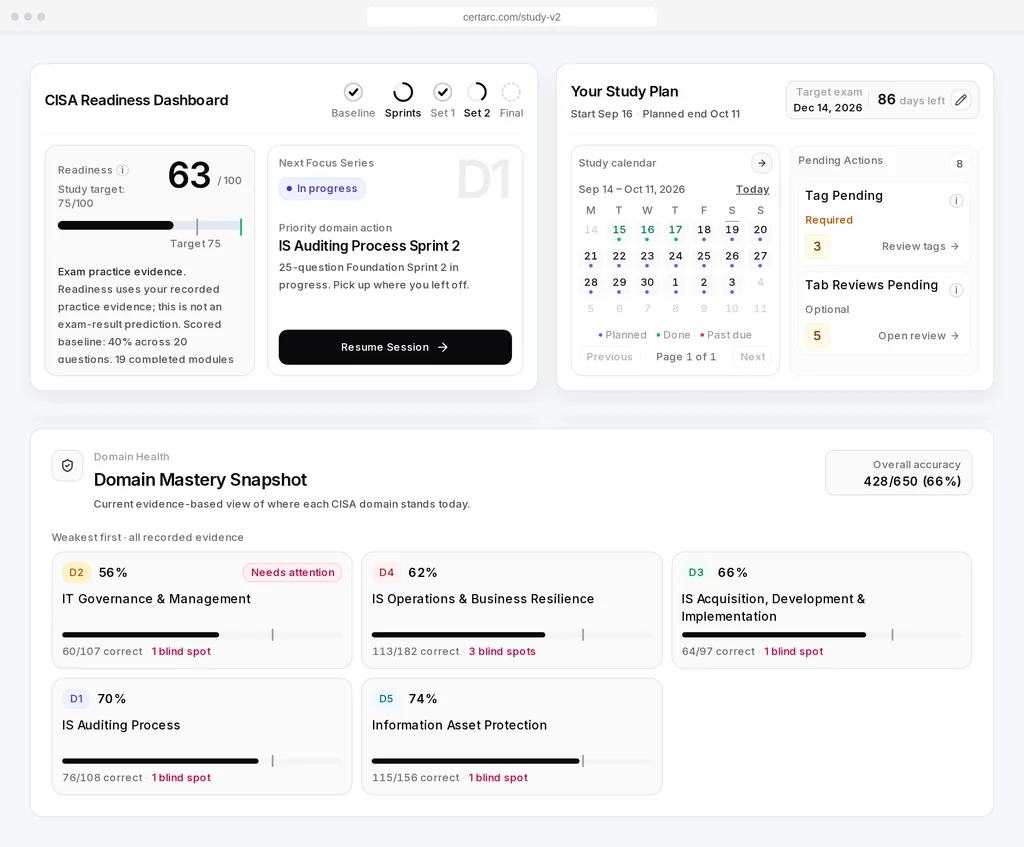
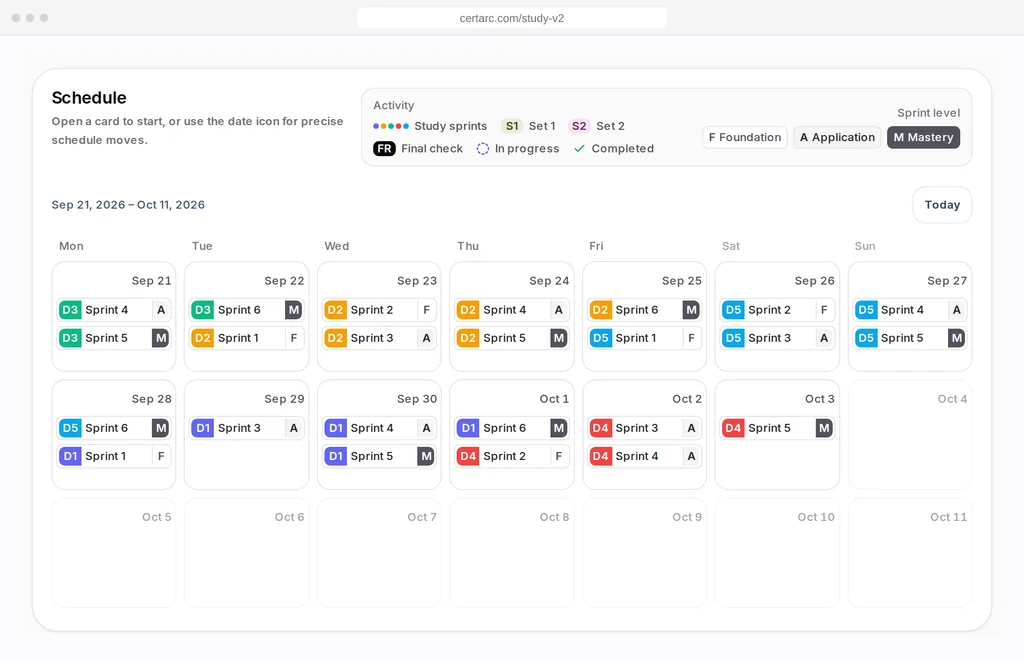
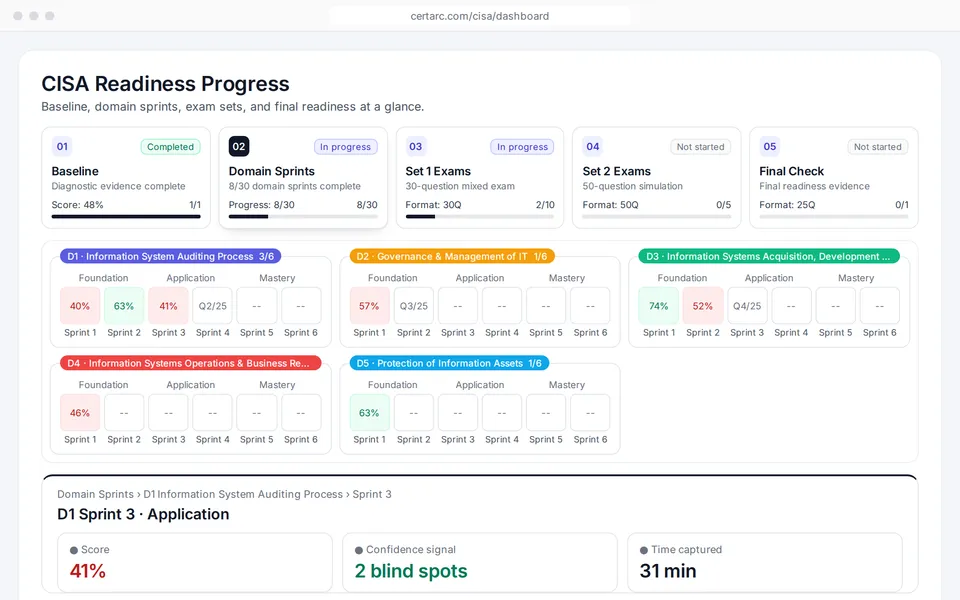
A free CertArc account opens 180 CISA questions, each with the full review, which compares every option: a 25-question baseline, a 25-question sprint in each of the five domains and a 30-question practice exam, over 21 days with no card. The 10 questions above are a sample you can answer without signing in. ISACA's own free CISA practice quiz has 10 questions.
| Free session | Questions | What it's for |
|---|---|---|
| Baseline | 25 | Your first readiness picture |
| Domain sprints | 125 (one 25-question sprint per domain) | Practising one domain at a time |
| Practice exam | 30 | The five domains mixed, as on the exam |
| All free questions | 180 | 21 days of free access, no card needed |
Answers to the 10 questions
All 10 sample questions are answered on this page, with no sign-in: the correct option, why it wins, the key takeaway and the exam trap. Try them in the set above first.
Question 1 · Information System Auditing Process
Question 2 · Information System Auditing Process
An assessor must design testing of 12,000 incident records for a technology platform. Executives prioritize high-impact service outages, prior exceptions cluster in one support region, reliable severity and region fields exist, and conclusions must cover the full population. Which sampling approach best supports the engagement?
- A. Design a simple random representative sample across all records and expand testing only if selected records reveal exceptions.
- B. Design a random representative sample across severity and region, then add high-impact and exception-region records for focused coverage.
- C. Design targeted testing of high-impact and exception-region records using documented criteria, and validate each against the incident procedure.
- D. Design interval-based selection across the full review period and corroborate observed patterns through documented supervisor interviews.
- Correct answer: B. Why this wins
- It preserves evidence for the full-population conclusion while deliberately examining high-impact outages and the region where exceptions cluster.
- Key takeaway
- When broad assurance and known variation coexist, keep representative evidence and add focused testing for the named risk groups.
- Exam trap
- Simple random testing sounds neutral, and targeted testing sounds risk-driven. Each becomes incomplete when used alone because the engagement requires breadth and deliberate depth.
Question 3 · Governance and Management of IT
A power-grid system owner must authorize a release that repurposes customer outage contacts for five-year demand analysis. Security testing passed, the approved privacy profile limits use to restoration and 30-day retention, and executives rank resilience analytics above release speed. Which principle should govern authorization?
- A. Authorize a monitored pilot under approved security controls, then update the privacy profile from observed impacts.
- B. Authorize after validating access controls and documenting extended retention in the system security plan.
- C. Authorize after the resilience committee records executive risk acceptance against the stated mission priority.
- D. Authorize only after privacy-risk re-evaluation aligns the new use and retention with approved risk tolerance.
- Correct answer: D. Why this wins
- It directly addresses the gap between the restoration-only, 30-day privacy profile and the proposed demand-analysis use with five-year retention. It also keeps security evidence and resilience priority in their proper role as inputs.
- Key takeaway
- When purpose or retention materially changes, reopen the privacy-risk decision before the accountable owner authorizes release.
- Exam trap
- Security testing speaks to safeguards, and resilience priority speaks to benefit. Neither resolves whether altered processing fits privacy values or approved risk tolerance.
Question 4 · Governance and Management of IT
During a bank’s core-platform replacement, the assessor finds that teams use revised operating procedures for critical services in the new environment, while the information-security policy and supporting standards still reference the retiring platform. Before evaluating technical compliance, what should the assessor verify first?
- A. Verify that the revised procedures are documented and approved by the platform-change authority.
- B. Verify that technical controls conform to revised procedures and record any implementation exceptions.
- C. Verify that senior management approved and communicated aligned updates to the policy, standards, and procedures.
- D. Verify that management accepted the risk of using standards written for the retiring platform.
- Correct answer: C. Why this wins
- It resolves the exact mismatch created by the platform replacement across policy, standards, and procedures. It also confirms approval and communication before technical evidence is judged.
- Key takeaway
- When technology changes the operating context, establish aligned governance authority before testing detailed compliance.
- Exam trap
- A procedure may be current and properly documented while its governing policy and standards remain tied to the retiring platform.
Question 5 · Information Systems Acquisition, Development, and Implementation
A manufacturer’s advisory security leader asks an IS auditor about a replacement business case; finance holds capital approval. Two feasible designs meet safety and output requirements, while the stronger-protection design exceeds the approved investment ceiling. Which principle should the auditor use to design the recommendation?
- A. Recommend comparing lifecycle value and security risk within approved constraints, then report the trade-off to finance.
- B. Recommend the stronger-protection design, then ask the security leader to approve a documented budget exception.
- C. Recommend production pilots of both designs, then compare lifecycle value after operational validation.
- D. Recommend the within-budget design, then record the added protection as a monitored future enhancement.
- Correct answer: A. Why this wins
- It compares the two feasible designs on lifecycle value, security risk, and the approved investment ceiling, then reports the resulting trade-off to finance without assuming management’s authority.
- Key takeaway
- When alternatives remain feasible, integrate value, risk, and constraints, then leave approval to the accountable owner.
- Exam trap
- Choosing on one attractive feature skips the integrated business case and may shift capital authority away from the finance function that owns it.
Question 6 · Information Systems Acquisition, Development, and Implementation
After a digital-banking release, the incident commander reports that recovery procedures contained a brief payment delay within the approved tolerance. The post-implementation review begins tomorrow. Which action should the IS auditor recommend to mitigate recurrence while preserving management accountability for remediation?
- A. Direct the application team to implement corrective changes and validate completion evidence.
- B. Assess incident evidence against release objectives and recommend management-owned corrective actions.
- C. Recommend suspending the digital-banking service and invoke the approved crisis process.
- D. Review recovery-procedure results and report them as the complete implementation outcome.
- Correct answer: B. Why this wins
- It uses the scheduled review to compare incident evidence with release objectives, identify improvements, and preserve management's accountability for corrective decisions and execution.
- Key takeaway
- During a post-implementation review, assess operating evidence and recommend improvements while leaving corrective execution with management.
- Exam trap
- The tempting leap is from finding a problem to directing its repair. Here, the auditor should turn the payment-delay evidence into recommendations, not commands.
Question 7 · Information Systems Operations and Business Resilience
During an assessment of a bank’s emergency change process, a critical security patch was deployed under documented approval to meet a mandated deadline. Required post-implementation validation remains unfinished while transaction processing is stable. Which recommendation should the assessor make to mitigate the resulting risk?
- A. Recommend immediate rollback and approved redeployment after full preproduction testing.
- B. Recommend that the assessor supervise patch validation and record results.
- C. Recommend monitoring transaction availability until the next scheduled change review.
- D. Recommend prompt completion and documentation of post-implementation patch validation.
- Correct answer: D. Why this wins
- This recommendation addresses the exact residual risk: management has authority for the deployed patch but lacks completed, retained evidence that implementation was correct.
- Key takeaway
- Treat emergency approval as permission to deploy, then seek documented validation before considering the change closed.
- Exam trap
- Stable transactions are relevant to availability, yet the stated deficiency is unfinished validation. Service continuity cannot replace implementation evidence.
Question 8 · Information Systems Operations and Business Resilience
During month-end triage, a professional-services development lead proposes rerunning an automated billing job before a client deadline in one hour. Its prerequisite export finished, the scheduler lacks final status, and operations can reconcile posted invoices in 20 minutes. Which governing principle should the IS auditor validate?
- A. Preserve the deadline through a monitored rerun, then reconcile invoice postings.
- B. Defer all rescheduling until root-cause analysis and scheduler correction are complete.
- C. Establish transaction state, then follow the approved recovery sequence before rescheduling.
- D. Validate export completion, then recommend the documented rerun procedure.
- Correct answer: C. Why this wins
- It directly addresses the missing final status and duplicate-posting uncertainty, then preserves the approved recovery sequence while the 20-minute reconciliation supports the one-hour objective.
- Key takeaway
- When an interrupted transaction job has an uncertain outcome, establish its committed state before evaluating an authorized rerun.
- Exam trap
- The 20-minute reconciliation supports timely recovery; it does not justify creating duplicate-posting exposure before the last committed state is established.
Question 9 · Protection of Information Assets
A manufacturing risk owner relies on an AI tool to prioritize penetration-test findings. Independent sampling shows accurate ranking for common flaws but inconsistent ranking of low-frequency flaws affecting safety-critical production systems. Before accepting the prioritized remediation queue, what should the IS auditor verify?
- A. That representative, risk-weighted test cases cover high-consequence edge cases and independently corroborate the AI rankings.
- B. That remediation owners approve the safety-critical queue and begin treatment before independent ranking validation is completed.
- C. That a validated benchmark confirms AI ranking accuracy for the common flaws represented in the original sample.
- D. That least-privilege access protects the AI tool and monitored changes preserve its approved configuration.
- Correct answer: A. Why this wins
- It targets the exact evidence gap: representative, risk-weighted cases cover rare safety-critical flaws, while independent corroboration tests whether their rankings can safely drive remediation priority.
- Key takeaway
- When a consequential segment is inconsistent, validate it with representative cases and independent evidence before relying on its priorities.
- Exam trap
- The common-flaw result is reassuring but already established. Reconfirming it does not answer whether inconsistent edge-case rankings can safely determine remediation order.
Question 10 · Protection of Information Assets
A consulting firm’s client-facing generative AI assistant begins returning excerpts from another client’s files. The security leader has paused new sessions; existing containers remain live, counsel requires defensible evidence, and notification depends on confirming access. Which evidence should the IS auditor validate first?
- A. Validate the approved model rollback record and post-change tests before tracing the affected client-file accesses.
- B. Validate preserved container-state captures and time-correlated assistant, retrieval, identity, and file-access logs with integrity and custody records.
- C. Validate notification approval against contractual thresholds and recorded impact estimates before examining supporting technical event data.
- D. Validate output-filter effectiveness and least-privilege retrieval settings through authorized production tests while the incident remains active.
- Correct answer: B. Why this wins
- It directly supports the unresolved access determination while protecting the integrity, provenance, and custody of volatile evidence from the live containers.
- Key takeaway
- When live-state evidence supports a required downstream decision, validate its preservation and correlation before later assurance work.
- Exam trap
- Rollback review, notification approval, and retrieval testing all matter, yet none first connects the assistant output to identities, retrieval events, and file access.
Worked example: which engagement fits the decision window
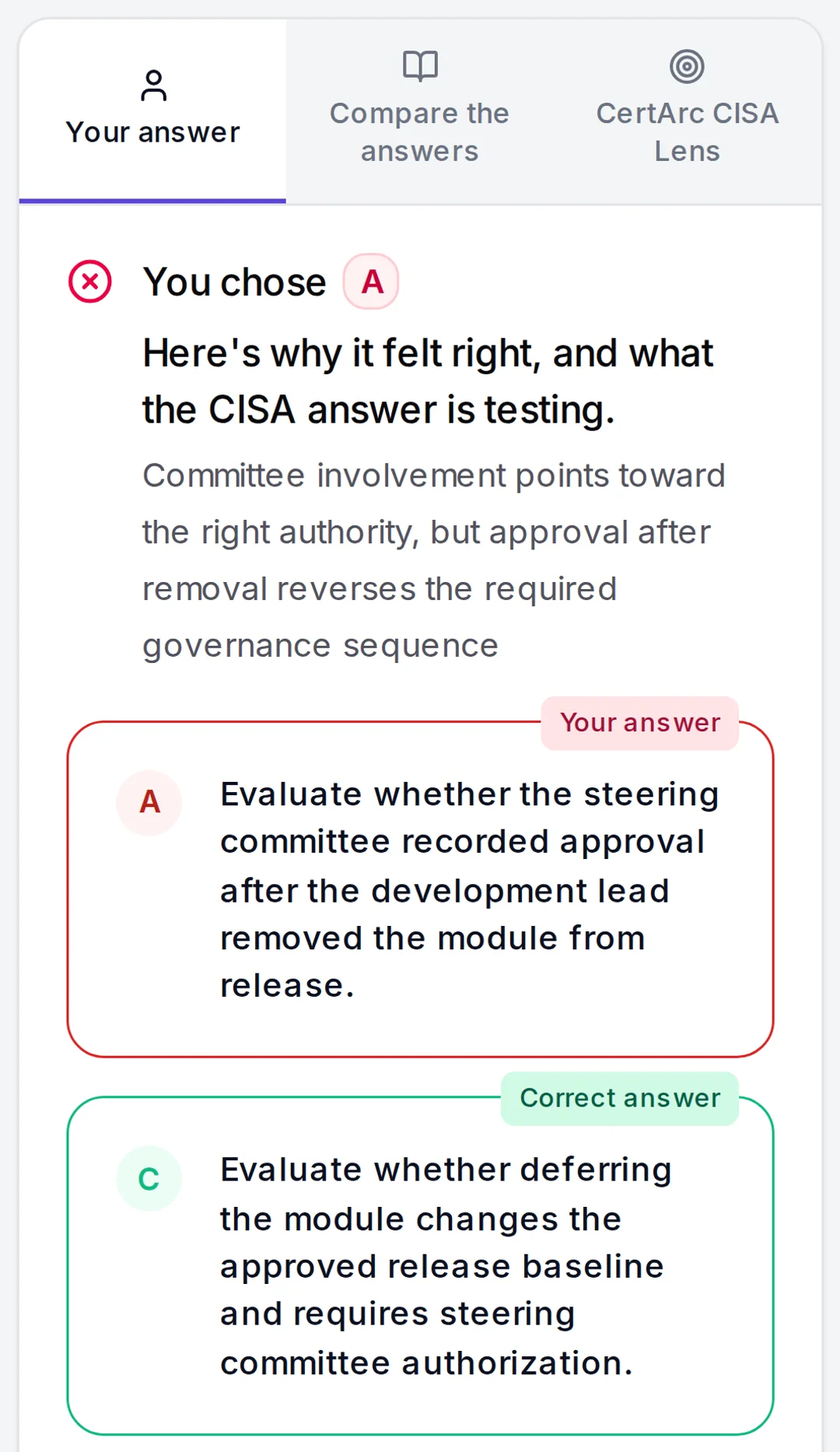
This answers question 1 option by option, in the words of the review a CertArc learner gets after answering it.
A public agency's replacement benefits system has reached design approval; configuration and migration start next quarter. The privacy officer needs independent findings before implementation decisions are finalized, allowing responses to design-stage privacy risks to be prioritized. Which engagement should the IS auditor design?
A. Design a preimplementation assessment examining privacy control specifications against defined requirements.
- Correct answer. Why this wins
- “It examines the replacement's privacy control specifications against defined requirements and delivers independent findings while implementation decisions can still be shaped.”
B. Design a management workshop assigning accountable owners and selecting migration safeguards.
- Why this may look right
- “The action instinct is legitimate: migration safeguards and accountable owners will matter soon. A workshop also appears responsive because configuration starts next quarter.”
- Where it breaks
- “The stated need is independent findings before responses are prioritized, while this workshop would have management select safeguards without the requested design assessment.”
C. Design an audit of current-system privacy operations against approved procedures.
- Why this may look right
- “The evidence instinct is sound: approved procedures and current records are auditable. Existing operations may also provide useful organizational context.”
- Where it breaks
- “Its object and evidence are misaligned because the pending decisions concern the replacement's specifications, not adherence to procedures in the current system.”
D. Design a postimplementation assessment testing operating privacy controls with validated procedures.
- Why this may look right
- “The effectiveness instinct is reasonable: observed control performance provides persuasive assurance. That evidence becomes valuable after implementation.”
- Where it breaks
- “The replacement is not operating, and findings are needed before implementation decisions are finalized, so postimplementation testing arrives after the decision window.”
Key takeaway: “When design decisions remain open, assess design artefacts against requirements before evaluating operation or directing treatment.”
Each wrong option answers a nearby question. B has management choose the safeguards: the right people, but the wrong task. C audits the wrong system. D audits at the wrong time. Before choosing, name three things: the decision being made, the system it concerns, and the stage that system has reached.
Questions 5 and 6 above test the same boundary from the other side. In 5, the auditor compares the two designs and reports the trade-off to finance; in 6, the auditor uses the post-implementation review to recommend corrective actions that management owns. Neither question has the auditor approve or direct. What decision rules do CISA questions test?
Where the CISA marks are
CISA is 150 multiple-choice questions in 4 hours. ISACA scores it from 200 to 800, and 450 passes.
| Domain | Weight | About, of 150 | On this page | Free sprint |
|---|---|---|---|---|
| 1. Information System Auditing Process | 18% | 27 | 2 | 25 |
| 2. Governance and Management of IT | 18% | 27 | 2 | 25 |
| 3. Information Systems Acquisition, Development, and Implementation | 12% | 18 | 2 | 25 |
| 4. Information Systems Operations and Business Resilience | 26% | 39 | 2 | 25 |
| 5. Protection of Information Assets | 26% | 39 | 2 | 25 |
Domains 4 and 5 are 52% of the exam between them, so those two sprints practise the domains that carry the most marks.
Two scoring facts free banks rarely mention. Every exam includes unscored pretest items, so the counts above are approximate. The domain lines on your score report are informational only. The pass depends on how many items you answer correctly in total. CISA exam domains and weights.
ISACA's free CISA practice next to CertArc's
ISACA's free CISA practice quiz has 10 questions. CertArc has 10 here and 180 with a free account.
| Source | Free | Beyond that |
|---|---|---|
| ISACA free CISA practice quiz | 10 questions; results after you submit a form | The CISA QAE database: 1,070 questions, six months' access, US$299 member / US$399 non-member; the CISA Review Manual, 28th edition |
| CertArc | 10 on this page; with a free account, 180 over 21 days in seven sessions, no card | Paid access |
Several results for this search sell CISA "dumps" or recalled questions. ISACA's candidate guide prohibits memorizing, recording or re-creating exam content, or helping anyone do so. Check any free bank's references, too: some still cite the 27th-edition Review Manual (2019).
For paid CISA banks side by side, see Best CISA practice exams compared.
What your QAE percentage does and doesn't tell you is in What does your CISA QAE score tell you?
Spending the 180 in 21 days
Seven sessions, about one every three days.
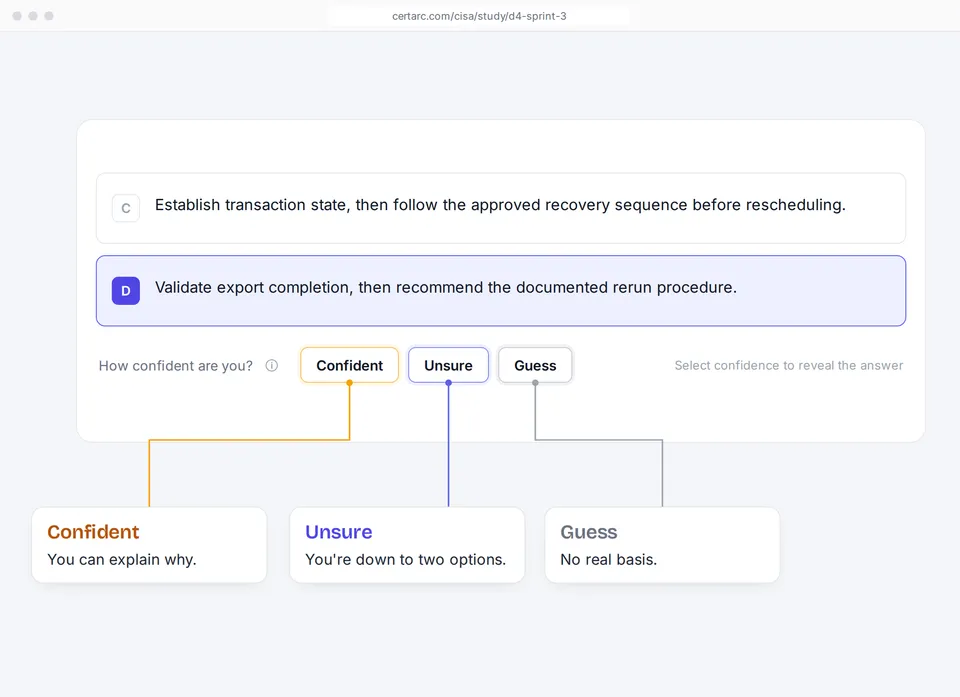
- Start with the 25-question baseline, tagging every answer Confident, Unsure or Guess before you submit it.
- Then the sprint for the domain your results name after "Start with".
- The Domain 4 and Domain 5 sprints, if neither was first: together they are 52% of the exam.
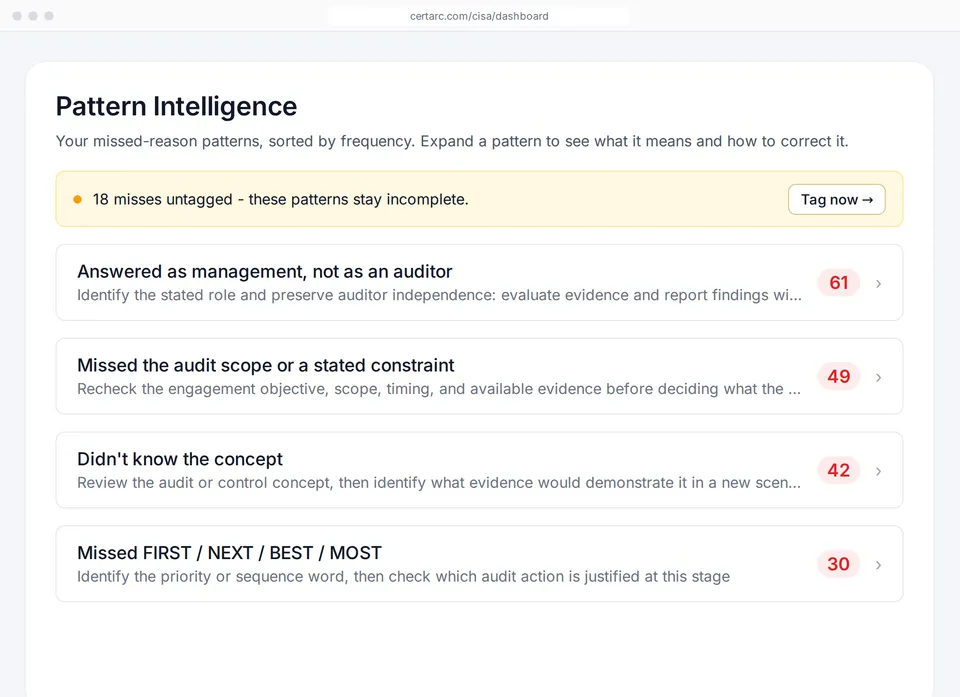
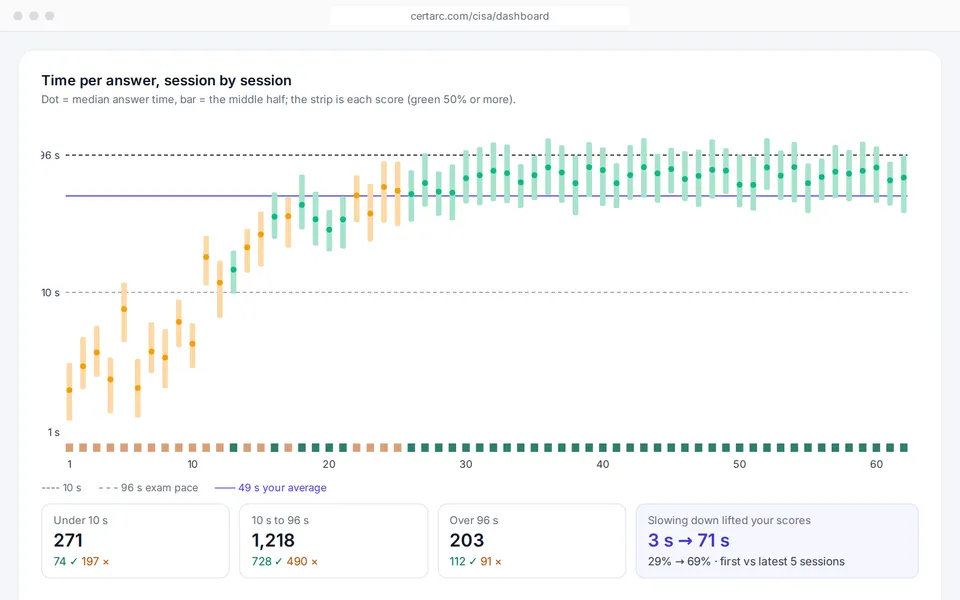
- After each session, go back to every answer you marked Confident that came back Incorrect. Its "Why this may look right" line in "Compare the answers" shows what in the stem pulled you off.
- The remaining sprints, then the 30-question practice exam.
Sources and fact check
Checked 16 November 2026. CertArc counts come from the live free path.