Last updated:
Why did I fail CISM after scoring well in QAE?
Executive Summary & Key Takeaway
Keep QAE in the study mix, but stop treating one percentage as the diagnosis. Audit whether the result came from transferable reasoning or familiarity, then repair the clearest domain, decision, confidence, or pacing gap with fresh practice.
ISACA describes QAE as an official preparation resource with practice, review, difficulty, and strengths-and-weaknesses features. ISACA also explains in its exam-strategy guidance that QAE is not a comprehensive set of examination questions and that the examination question bank is different.
That boundary does not make a QAE result unhelpful. It means the percentage should be read alongside evidence of transfer: can you apply the same decision rule when the wording, domain, roles, and tempting alternatives change?
Should I use a different CISM practice tool after QAE?
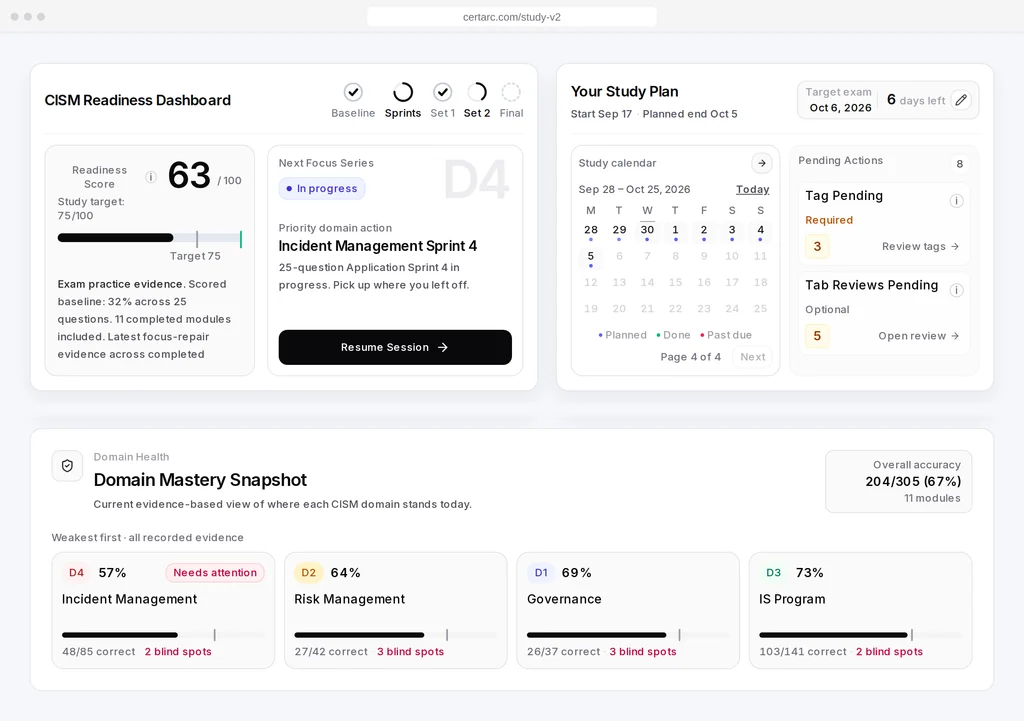
Possibly, but only if the second method gives you different evidence. Moving from one score-focused question bank to another may repeat the same review habit. A useful second tool should test unfamiliar scenarios, require you to compare every answer choice, show whether confidence matches accuracy, and separate domain gaps from recurring reasoning errors. CertArc is designed to provide those signals alongside official ISACA material.
What should a second practice tool add?
| What needs testing | Useful evidence | How CertArc supports it |
|---|---|---|
| Reasoning transfer | Apply the same decision rule to unfamiliar wording, roles, and constraints. | Original scenario practice across the four CISM domains. |
| Distractor judgment | Explain why each plausible choice is weaker, not only which choice is correct. | Four-choice review and CISM Lens explanations. |
| Confidence accuracy | Compare certainty with outcomes and prioritize confident-but-wrong answers. | Confidence signals and blind-spot analysis. |
| Recurring mistake patterns | Record why tempting answers keep winning across different scenarios. | Missed-reason tags and recurring pattern analysis. |
| Domain balance and next focus | Separate a broad score from domain and knowledge-area evidence. | Domain and knowledge-area signals with focused review. |
CertArc does not replace QAE or predict an examination result. It organizes practice evidence so a candidate can choose a more focused next step.
See CertArc in action
Turn practice evidence into a focused next step.
Bring domain health, blind spots, and the next study sprint into one view as fresh practice evidence accumulates.
This is useful if
- ✓you scored well in QAE but did not pass CISM
- ✓the examination choices felt less familiar than your practice set
- ✓several options appeared plausible and you could not rank them
- ✓you want to keep using official material without repeating the same review method
- ✓you need evidence for what to change before a retake
This is not for
This page does not diagnose one universal cause, criticize ISACA QAE, reconstruct live examination items, or convert a practice score into a pass prediction.
QAE-to-exam transfer audit
Use the six checks below as a review sequence. A single result may point to more than one gap, so start with the signal supported by your score report, practice history, and review notes.
| Signal | What it reveals | What to do next |
|---|---|---|
| Familiarity versus transfer | Your score rises on repeated items, but the same decision rule is harder to apply when the scenario, roles, or wording changes. | Use fresh mixed scenarios and state the governing rule before checking the explanation. Track whether the rule transfers, not whether the wording feels familiar. |
| Distractor explanation test | You can identify the correct practice answer but cannot explain why each of the other three choices is weaker in that situation. | Compare all four choices. Name where each distractor breaks on ownership, sequence, risk priority, scope, or business impact. |
| Confident-wrong blind spots | Some incorrect answers felt obvious or certain, which may indicate that confidence is outpacing the quality of the decision rule. | Review confident misses before low-confidence misses. Record why the tempting choice felt right, then test that same trap in a new scenario. |
| Domain and knowledge-area balance | A strong overall percentage may conceal a weaker domain or knowledge area, especially when practice is not evenly mixed. | Use the official outline and your available domain evidence to select one repair area, then confirm it with fresh cross-domain practice. |
| Managerial decision level | You choose an effective technical action when the scenario is asking for governance, risk ownership, approval, prioritization, or escalation. | Label the requested decision level before reading the options. Separate who is accountable from who executes the work. |
| Pace and qualifier control | Words such as FIRST, BEST, MOST, PRIMARY, or ULTIMATELY are missed, or time pressure shortens the comparison between plausible choices. | Track qualifier misses and pace separately. Slow the decision step enough to identify the requested order, owner, or priority before selecting. |
Familiarity versus transfer
What it reveals: Your score rises on repeated items, but the same decision rule is harder to apply when the scenario, roles, or wording changes.
What to do next: Use fresh mixed scenarios and state the governing rule before checking the explanation. Track whether the rule transfers, not whether the wording feels familiar.
Distractor explanation test
What it reveals: You can identify the correct practice answer but cannot explain why each of the other three choices is weaker in that situation.
What to do next: Compare all four choices. Name where each distractor breaks on ownership, sequence, risk priority, scope, or business impact.
Confident-wrong blind spots
What it reveals: Some incorrect answers felt obvious or certain, which may indicate that confidence is outpacing the quality of the decision rule.
What to do next: Review confident misses before low-confidence misses. Record why the tempting choice felt right, then test that same trap in a new scenario.
Domain and knowledge-area balance
What it reveals: A strong overall percentage may conceal a weaker domain or knowledge area, especially when practice is not evenly mixed.
What to do next: Use the official outline and your available domain evidence to select one repair area, then confirm it with fresh cross-domain practice.
Managerial decision level
What it reveals: You choose an effective technical action when the scenario is asking for governance, risk ownership, approval, prioritization, or escalation.
What to do next: Label the requested decision level before reading the options. Separate who is accountable from who executes the work.
Pace and qualifier control
What it reveals: Words such as FIRST, BEST, MOST, PRIMARY, or ULTIMATELY are missed, or time pressure shortens the comparison between plausible choices.
What to do next: Track qualifier misses and pace separately. Slow the decision step enough to identify the requested order, owner, or priority before selecting.
Does a high QAE score mean I was exam-ready?
No single practice percentage can establish exam readiness. A QAE score is evidence from a specific practice environment. It becomes more useful when it is supported by balanced domain performance, accurate confidence, controlled pacing, and the ability to solve unfamiliar scenarios with the same reasoning.
Repeated exposure can also change what the score measures. If you remember the item or explanation, the result may include both knowledge and familiarity. That is a reason to add a transfer check, not a reason to discard QAE.
Why can the CISM exam feel different from QAE?
ISACA states that its examination question bank is different from the QAE question set. It is therefore reasonable for candidates to encounter less familiar wording and combinations of facts, roles, or constraints.
Feeling that the questions were different does not by itself identify the cause of a failed result. The useful follow-up is to inspect where your choices became unstable: a particular domain, two plausible answers, confidence, timing, or the managerial level of the decision.
Did I memorize QAE instead of learning the reasoning?
You may be relying on familiarity if you can recall the correct option but cannot explain why the other three options lose, or if performance falls sharply when roles and wording change. Test this with original scenarios that use the same principle in a different setting.
Consider this original practice scenario: a team discovers that a proposed cloud service exceeds the current risk tolerance. One option immediately deploys a compensating control; another sends the decision to the accountable risk owner with impact and treatment options. If you memorized a control-first pattern, the first answer may feel productive. If you learned the ownership rule, you first identify who accepts or changes the risk decision, then place technical execution in the approved treatment plan.
Why did several answer choices seem plausible or incorrect?
CISM preparation often requires ranking defensible actions, not merely finding one action that could work. Two options may both describe useful work, but one can be stronger because it addresses the requested sequence, decision owner, business objective, or level of accountability.
When every option appears wrong, rewrite the question in one line: who must decide what, and at what point? Then eliminate choices that answer a later step, assign authority to an executor, ignore the stated constraint, or solve a narrower technical problem.
What should I change before my CISM retake?
Keep the official outline and QAE in the plan, but change what you collect from practice. For each missed or uncertain question, record the domain, knowledge area, confidence, missed reason, decision level, qualifier, and the rule that should transfer to a new scenario.
Choose the next study block from that evidence. Repair a domain gap with source review and fresh scenarios; repair a distractor or managerial-level gap with four-choice comparison; repair confidence or pace with targeted review and timed mixed practice. Use ISACA retake policy and your official score report as boundaries for scheduling.
Common approaches that fall short
- Repeating the same QAE items until the percentage rises can strengthen familiarity without showing whether the decision rule transfers.
- Treating every miss as a knowledge gap can hide ownership, sequencing, qualifier, confidence, or pacing problems.
- Replacing official material with another question bank does not fix the review method unless the candidate compares distractors and records why the miss occurred.
Related questions candidates ask
- Is QAE enough to pass CISM?
- Can repeated QAE practice inflate confidence?
- Why did CISM questions feel unfamiliar after QAE?
- Why do two CISM answers both seem correct?
- How should I prepare differently for a CISM retake?
Choose your next step
Failed After QAE FAQ
Is QAE enough to pass CISM?
QAE is an official preparation resource, but no practice resource or percentage can guarantee a pass. Use it with the official outline and check whether the reasoning transfers to fresh scenarios across all four domains.
Can repeated QAE practice inflate confidence?
Repeated practice can make wording and explanations familiar. ISACA cautions that repeated familiarity can create false comfort. Compare repeated scores with fresh mixed scenarios, confidence accuracy, and your ability to explain every distractor.
Why did CISM questions feel unfamiliar after QAE?
ISACA states that the examination question bank differs from the QAE question set. Less familiar wording is therefore possible, but only your wider evidence can show whether the main gap involved domain knowledge, transfer, decision level, confidence, or pace.
Should I stop using QAE after failing?
Not automatically. Keep QAE for official practice and review, but add fresh scenarios and a structured transfer audit so you are not repeating the same method without learning why choices became unstable.
Should I use a different CISM practice tool after QAE?
Possibly, but only if it gives you different evidence. Look for fresh scenarios, all-choice review, confidence accuracy, missed-reason patterns, and domain balance rather than another percentage alone. CertArc provides those study signals alongside official ISACA material; it does not replace QAE or predict an examination result.
What should I do differently before a retake?
Review the official score report, audit the six transfer signals, and focus the next study block on the strongest evidence. Record why each tempting option loses, then retest the rule with unfamiliar mixed scenarios before scheduling from confidence alone.
Does CertArc replace QAE?
No. CertArc is a separate practice and diagnostic platform that can be used alongside official ISACA material. It focuses on original scenarios, four-choice reasoning, confidence, missed reasons, and domain and knowledge-area signals.
Can CertArc predict whether I will pass the retake?
No. CertArc does not predict or guarantee an examination result. It organizes practice evidence so you can choose a more focused next step and see whether the same gaps continue in later work.
