Last updated:
CISSP readiness
How should you review wrong CISSP practice answers?
Direct answer
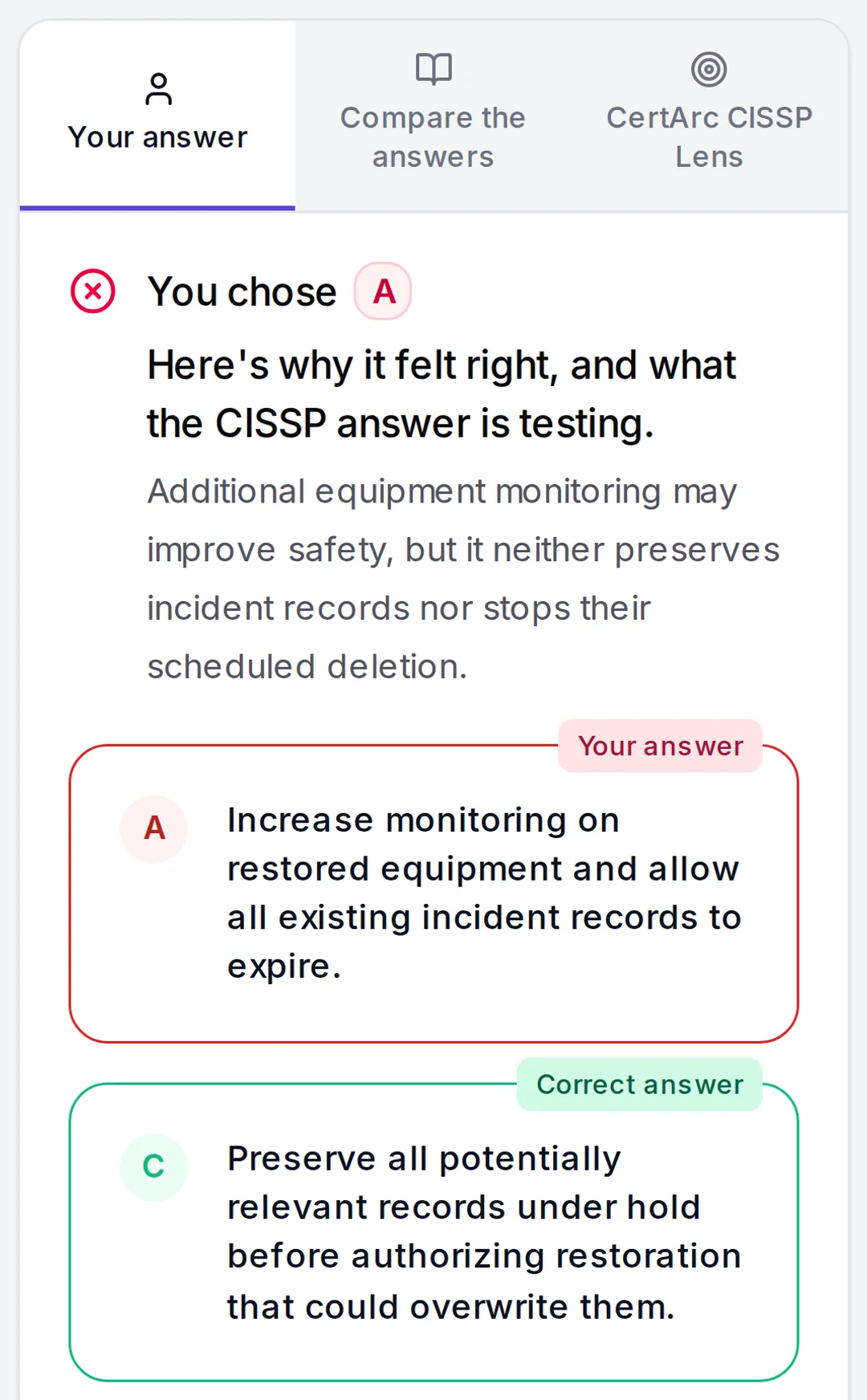
Review a wrong CISSP answer by reconstructing the actor, authority, objective, qualifier, constraints, and decision level, then explain why every option wins or loses. Classify the miss as knowledge, authority, sequence, scope and risk, or confidence and recognition before choosing the next practice task. First, hide the explanation and restate the decision rule in your own words, then verify the decision on unfamiliar scenarios and explain why the strongest distractor loses.
wrong-answer review: a practical decision framework
| Check | How to use it |
|---|---|
| Objective | Classify the miss as knowledge, authority, sequence, scope and risk, or confidence and recognition before choosing the next practice task. |
| First move | hide the explanation and restate the decision rule in your own words |
| Common trap | Reading only the correct rationale, recording the right letter, and immediately repeating a near-identical item. |
wrong-answer review in practice
A learner selects encryption because it reduces exposure, while the question asks a data owner for the first action after discovering unclassified information.
Encryption may be useful later, but the miss is ownership and sequence. The learner should identify classification responsibility before selecting handling controls.
What matters most for wrong-answer review
Classify the miss as knowledge, authority, sequence, scope and risk, or confidence and recognition before choosing the next practice task.
Review a wrong CISSP answer by reconstructing the actor, authority, objective, qualifier, constraints, and decision level, then explain why every option wins or loses. The useful question is not whether an isolated fact looks familiar, but whether you can apply it under the actor, authority, objective, qualifier, and constraints in the scenario.
How to work on wrong-answer review
hide the explanation and restate the decision rule in your own words
For wrong-answer review, preserve first-attempt evidence and confidence before reading the rationale. Review every option, name the transferable decision rule, and wait for unfamiliar evidence before deciding that the weakness is repaired.
- Name the actor and the authority that actor holds.
- Underline the qualifier and the required business or security outcome.
- Check sequence, scope, constraints, and residual risk before choosing.
The mistake that distorts wrong-answer review
Reading only the correct rationale, recording the right letter, and immediately repeating a near-identical item.
This error can survive repeated question practice when review stops at the correct letter. Rework the item until you can state the transferable rule without quoting the stem.
What useful progress looks like for wrong-answer review
Encryption may be useful later, but the miss is ownership and sequence. The learner should identify classification responsibility before selecting handling controls.
Retest wrong-answer review with a changed actor, qualifier, constraint, or domain context. Keep the result only when the same reasoning survives unfamiliar wording and you can explain what evidence would make another option stronger.
- Use an unfamiliar scenario rather than a repeated item.
- Record confidence before opening the explanation.
- Name the evidence that would reverse the decision.
Sources and fact check
Source checked: 2026-08-24
- CertArc is an independent exam-preparation platform and is not affiliated with or endorsed by ISC2.
- CertArc uses original practice questions, not live or recalled exam items, and does not reproduce the CISSP CAT algorithm.
- Practice performance is study evidence, not a pass prediction or guarantee.
Frequently asked questions
How should you review wrong CISSP practice answers?
Review a wrong CISSP answer by reconstructing the actor, authority, objective, qualifier, constraints, and decision level, then explain why every option wins or loses. Classify the miss as knowledge, authority, sequence, scope and risk, or confidence and recognition before choosing the next practice task. First, hide the explanation and restate the decision rule in your own words, then verify the decision on unfamiliar scenarios and explain why the strongest distractor loses.
What should I do first with wrong-answer review?
Hide the explanation and restate the decision rule in your own words. Capture first-attempt evidence before adding more repeated questions or materials.
What does useful wrong-answer review review include?
Classify the miss as knowledge, authority, sequence, scope and risk, or confidence and recognition before choosing the next practice task. Review every option, confidence, and the rule that should transfer to a changed scenario.
What commonly distorts wrong-answer review results?
Reading only the correct rationale, recording the right letter, and immediately repeating a near-identical item. Use unfamiliar items and consistent conditions to reduce that distortion.
Does wrong-answer review performance predict a CISSP pass?
No. It is one study signal alongside eight-domain coverage, unfamiliar-item stability, confidence calibration, pacing, and review quality.