Last updated:
CISSP practice
Where can you try free CISSP practice questions with explanations?
Direct answer
CertArc provides eight original public CISSP samples, one per current domain, with four choices, a single best answer, and explanations for every option. Use the samples to inspect question and explanation quality, not to estimate your exam result from eight items. First, answer each scenario before opening the rationale and write down why your runner-up loses, then verify the decision on unfamiliar scenarios and explain why the strongest distractor loses.
Eight original public samples
These are original CertArc questions, not live, recalled, or official ISC2 exam items. They are kept in a separate public-sample inventory and are not part of CertArc’s operational question bank.
Question 1: Domain 1
Outline mapping: Understand and apply risk management concepts; Identify and apply risk ownership and accountability. Editorial quality checks passed 24 August 2026; this public-only sample is excluded from operational assessments.
A business unit cannot meet a new security standard before a product launch. The security architect has proposed compensating controls, but material residual risk remains above the team’s delegated threshold.
Who should decide whether to accept the remaining risk?
- A. The security architect who designed the compensating controls
- B. The accountable business risk owner or delegated executive authority
- C. The control operator who will monitor the exception
- D. The external assessor who identified the control gap
Show the answer and all four explanations
Reasoning rule: Risk acceptance belongs to accountable business authority; security specialists assess, recommend, implement, and monitor.
CISSP Lens error: Role and authority error
A: Weaker: The architect can assess and recommend controls, but technical expertise does not automatically grant authority to accept material business risk.
B: Strongest: The accountable business owner weighs residual exposure against business objectives and accepts, rejects, or escalates risk within delegated authority.
C: Weaker: The operator implements and monitors the approved treatment. Operating the control does not transfer ownership of the business exposure.
D: Weaker: An assessor provides independent findings and evidence. Making the treatment decision would compromise the separation between assurance and ownership.
Question 2: Domain 2
Outline mapping: Identify and classify information and assets; Establish information and asset handling requirements. Editorial quality checks passed 24 August 2026; this public-only sample is excluded from operational assessments.
A storage administrator discovers an unlabeled dataset containing customer and operational records. Encryption is available, but the administrator does not know the business sensitivity, retention duty, or approved users.
What should happen first?
- A. Encrypt the entire dataset with the strongest available algorithm
- B. Ask the accountable data owner to classify the information and define handling
- C. Delete the dataset because its classification is unknown
- D. Allow current access until the next annual review
Show the answer and all four explanations
Reasoning rule: The data owner decides classification and authorized use; the custodian implements handling and protection.
CISSP Lens error: Sequence error
A: Weaker: Encryption may be required later, but selecting a handling control before classification and ownership can miss retention, access, and business requirements.
B: Strongest: The owner supplies business context and makes classification and access decisions. The custodian can then implement the approved handling controls.
C: Weaker: Deletion could violate business, preservation, or retention obligations. Unknown classification is a reason to protect and escalate, not destroy.
D: Weaker: Continuing unverified access leaves the exposure unresolved. The administrator should protect the data and promptly obtain an accountable classification decision.
Question 3: Domain 3
Outline mapping: Apply security engineering principles; Assess and mitigate vulnerabilities in security architectures. Editorial quality checks passed 24 August 2026; this public-only sample is excluded from operational assessments.
A proposed authentication service removes local password stores but routes every business application through one regional component. The design review has not evaluated failure, compromise, or recovery dependencies.
What is the best next design action?
- A. Approve the design because central authentication is always safer
- B. Add a second identical component without assessing shared dependencies
- C. Perform threat and failure analysis, then design proportionate resilience
- D. Return to separate password stores for every application
Show the answer and all four explanations
Reasoning rule: Evaluate security and resilience assumptions before selecting an architecture pattern or compensating design.
CISSP Lens error: Scope and risk trade-off error
A: Weaker: Centralization can improve control but also concentrates dependency and compromise impact. “Always safer” ignores availability and trust-boundary analysis.
B: Weaker: A duplicate that shares the same region, control plane, or failure cause may not provide meaningful resilience or reduce concentration risk.
C: Strongest: Architecture decisions should follow explicit threat, dependency, failure, recovery, and business-impact analysis before a specific resilience pattern is chosen.
D: Weaker: Reverting discards potential benefits without assessing alternatives. The missing step is analysis, not an automatic preference for decentralization.
Question 4: Domain 4
Outline mapping: Apply secure network architecture design principles; Implement secure communication channels according to design. Editorial quality checks passed 24 August 2026; this public-only sample is excluded from operational assessments.
A support vendor needs temporary access to one management service. The network team proposes broad access to the management subnet because it is faster than defining a narrow path.
Which network approach is most appropriate?
- A. Permit the entire subnet from the vendor network during business hours
- B. Create a restricted, monitored path to the required service for the approved period
- C. Disable all vendor access and require an employee to share a screen
- D. Place the vendor device directly on the internal management network
Show the answer and all four explanations
Reasoning rule: Design the narrowest monitored network path that still satisfies the authorized business task.
CISSP Lens error: Scope and risk trade-off error
A: Weaker: A time window reduces duration but not unnecessary reach. Broad subnet access exceeds the vendor’s stated task and increases lateral exposure.
B: Strongest: A task-specific path applies least privilege, segmentation, monitoring, and time bounds while preserving the authorized support objective.
C: Weaker: Removing required access may prevent the approved task and can create unsafe workarounds. The goal is controlled access, not zero access by default.
D: Weaker: Direct placement weakens trust boundaries and exposes additional services. It does not match the narrow support requirement or minimize reachable assets.
Question 5: Domain 5
Outline mapping: Manage the identity and access provisioning lifecycle; Implement and manage authorization mechanisms. Editorial quality checks passed 24 August 2026; this public-only sample is excluded from operational assessments.
A privileged administrator transfers to a nontechnical management role. The identity team can remove access, but the business manager has not reviewed which privileges remain necessary.
Who should determine the administrator’s continuing access need?
- A. The identity platform administrator
- B. The employee, because they understand their past duties
- C. The accountable manager or application owner through the access review process
- D. The security monitoring team after observing use for ninety days
Show the answer and all four explanations
Reasoning rule: Accountable managers and resource owners decide business need; identity custodians implement lifecycle changes.
CISSP Lens error: Role and authority error
A: Weaker: The platform administrator implements approved changes but usually lacks the business context and authority to define the employee’s continuing job need.
B: Weaker: The employee can provide context but should not approve their own privileged access. Self-approval conflicts with accountable review and least privilege.
C: Strongest: The responsible owner validates business need and approves removal or retention. The identity team then implements and records the decision.
D: Weaker: Waiting preserves unnecessary privilege and observed use does not establish authorization. Review should occur promptly when role responsibilities change.
Question 6: Domain 6
Outline mapping: Design and validate assessment strategies; Conduct security control testing. Editorial quality checks passed 24 August 2026; this public-only sample is excluded from operational assessments.
A control owner designed a new payment approval control, configured it, operates it daily, and is asked to provide the only independent assurance opinion before launch.
What is the main concern?
- A. The control owner may not have enough technical knowledge
- B. The assessment lacks sufficient independence from control ownership
- C. The control should be automated before any assessment occurs
- D. The launch must be cancelled permanently
Show the answer and all four explanations
Reasoning rule: Assurance strength depends on objective evidence and independence appropriate to the risk and decision.
CISSP Lens error: Role and authority error
A: Weaker: The scenario gives no evidence of a knowledge gap. The material concern is objectivity when one person designs, operates, and solely assures the control.
B: Strongest: Independent assurance needs appropriate separation from design and operation. Otherwise bias or self-review can weaken confidence in the conclusion.
C: Weaker: Automation is not a prerequisite for assessment and does not solve independence. Manual controls can be assessed against defined design and operating criteria.
D: Weaker: The facts support obtaining appropriate independent assessment, not a permanent cancellation. Treatment should remain proportionate to the assurance gap.
Question 7: Domain 7
Outline mapping: Conduct incident management; Understand and support investigations. Editorial quality checks passed 24 August 2026; this public-only sample is excluded from operational assessments.
An approved incident procedure authorizes containment of a compromised host. Volatile process and network evidence may disappear, while a full disk image will take several hours.
What should the responder do next?
- A. Rebuild the host immediately to restore a trusted state
- B. Collect authorized volatile evidence, document it, and contain according to plan
- C. Wait for a full disk image before taking any containment action
- D. Ask the system user to copy any files they consider important
Show the answer and all four explanations
Reasoning rule: Coordinate authorized containment with evidence volatility, integrity, documentation, and business impact.
CISSP Lens error: Sequence error
A: Weaker: Immediate rebuilding can destroy volatile evidence and skip containment and scope decisions. Restoration belongs later in the authorized response sequence.
B: Strongest: This balances evidence volatility with the approved containment objective while preserving documentation, integrity, and response authority.
C: Weaker: Waiting may allow continued harm. Evidence and containment should be coordinated under the plan rather than forcing one absolute action first.
D: Weaker: An untrained user could alter evidence and expand contamination. Collection should follow authorized procedures, documented tools, and custody requirements.
Question 8: Domain 8
Outline mapping: Integrate security in the software development lifecycle; Identify and apply software security controls. Editorial quality checks passed 24 August 2026; this public-only sample is excluded from operational assessments.
A critical open-source library vulnerability affects production. A developer has a replacement ready, but dependency impact, testing, rollback, and deployment authorization are incomplete.
What is the best way to proceed?
- A. Deploy immediately because security fixes override change control
- B. Use the approved emergency change process with proportionate testing and rollback
- C. Wait for the next normal quarterly release regardless of exposure
- D. Accept the vulnerability because open-source components have no owner
Show the answer and all four explanations
Reasoning rule: Urgent secure development changes still require proportionate authorization, testing, rollback, verification, and documentation.
CISSP Lens error: Sequence error
A: Weaker: Urgency can invoke an emergency path but does not erase impact analysis, authority, testing, rollback, communication, or verification responsibilities.
B: Strongest: The emergency process addresses urgency while preserving accountable authorization, dependency review, targeted validation, rollback, and post-change evidence.
C: Weaker: A fixed delay ignores current risk and available emergency governance. The organization should use the risk-appropriate approved change path.
D: Weaker: Component origin does not remove organizational ownership of deployed software risk. Accountable owners must assess and treat the exposure.
free CISSP practice questions: a practical decision framework
| Check | How to use it |
|---|---|
| Objective | Use the samples to inspect question and explanation quality, not to estimate your exam result from eight items. |
| First move | answer each scenario before opening the rationale and write down why your runner-up loses |
| Common trap | Searching for recalled exam items or treating a tiny public sample as a pass-rate calculator. |
free CISSP practice questions in practice
A candidate gets seven of eight samples correct but guessed between the final two options on four questions and cannot explain the relevant authority boundaries.
The result shows promising recognition but weak confidence calibration. Review the four uncertain items and then test the same rules on unfamiliar scenarios.
What matters most for free CISSP practice questions
Use the samples to inspect question and explanation quality, not to estimate your exam result from eight items.
CertArc provides eight original public CISSP samples, one per current domain, with four choices, a single best answer, and explanations for every option. The useful question is not whether an isolated fact looks familiar, but whether you can apply it under the actor, authority, objective, qualifier, and constraints in the scenario.
How to work on free CISSP practice questions
answer each scenario before opening the rationale and write down why your runner-up loses
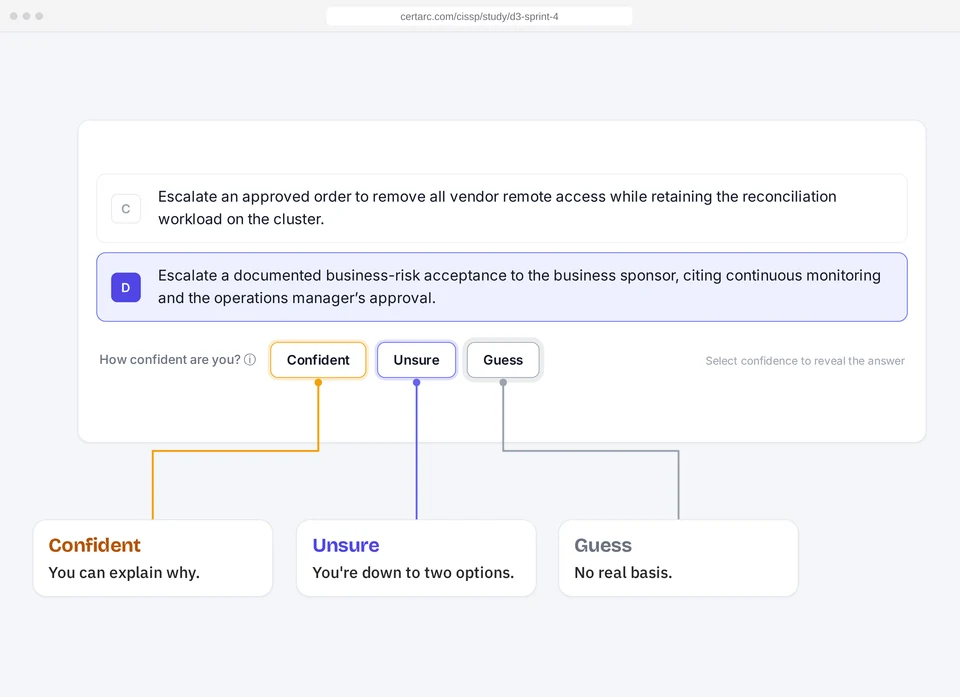
For free CISSP practice questions, preserve first-attempt evidence and confidence before reading the rationale. Review every option, name the transferable decision rule, and wait for unfamiliar evidence before deciding that the weakness is repaired.
- Name the actor and the authority that actor holds.
- Underline the qualifier and the required business or security outcome.
- Check sequence, scope, constraints, and residual risk before choosing.
The mistake that distorts free CISSP practice questions
Searching for recalled exam items or treating a tiny public sample as a pass-rate calculator.
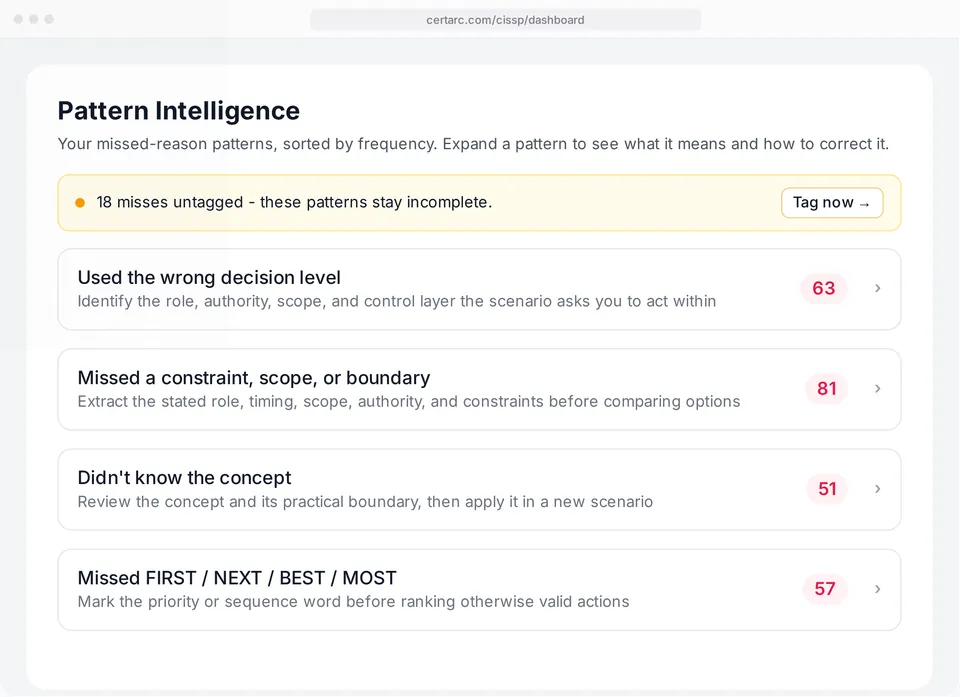
This error can survive repeated question practice when review stops at the correct letter. Rework the item until you can state the transferable rule without quoting the stem.
What useful progress looks like for free CISSP practice questions
The result shows promising recognition but weak confidence calibration. Review the four uncertain items and then test the same rules on unfamiliar scenarios.
Retest free CISSP practice questions with a changed actor, qualifier, constraint, or domain context. Keep the result only when the same reasoning survives unfamiliar wording and you can explain what evidence would make another option stronger.
- Use an unfamiliar scenario rather than a repeated item.
- Record confidence before opening the explanation.
- Name the evidence that would reverse the decision.
Sources and fact check
Source checked: 2026-08-24
- CertArc is an independent exam-preparation platform and is not affiliated with or endorsed by ISC2.
- CertArc uses original practice questions, not live or recalled exam items, and does not reproduce the CISSP CAT algorithm.
- Practice performance is study evidence, not a pass prediction or guarantee.
Frequently asked questions
Where can you try free CISSP practice questions with explanations?
CertArc provides eight original public CISSP samples, one per current domain, with four choices, a single best answer, and explanations for every option. Use the samples to inspect question and explanation quality, not to estimate your exam result from eight items. First, answer each scenario before opening the rationale and write down why your runner-up loses, then verify the decision on unfamiliar scenarios and explain why the strongest distractor loses.
What should I do first with free CISSP practice questions?
Answer each scenario before opening the rationale and write down why your runner-up loses Capture first-attempt evidence before adding more repeated questions or materials.
What does useful free CISSP practice questions review include?
Use the samples to inspect question and explanation quality, not to estimate your exam result from eight items. Review every option, confidence, and the rule that should transfer to a changed scenario.
What commonly distorts free CISSP practice questions results?
Searching for recalled exam items or treating a tiny public sample as a pass-rate calculator. Use unfamiliar items and consistent conditions to reduce that distortion.
Does free CISSP practice questions performance predict a CISSP pass?
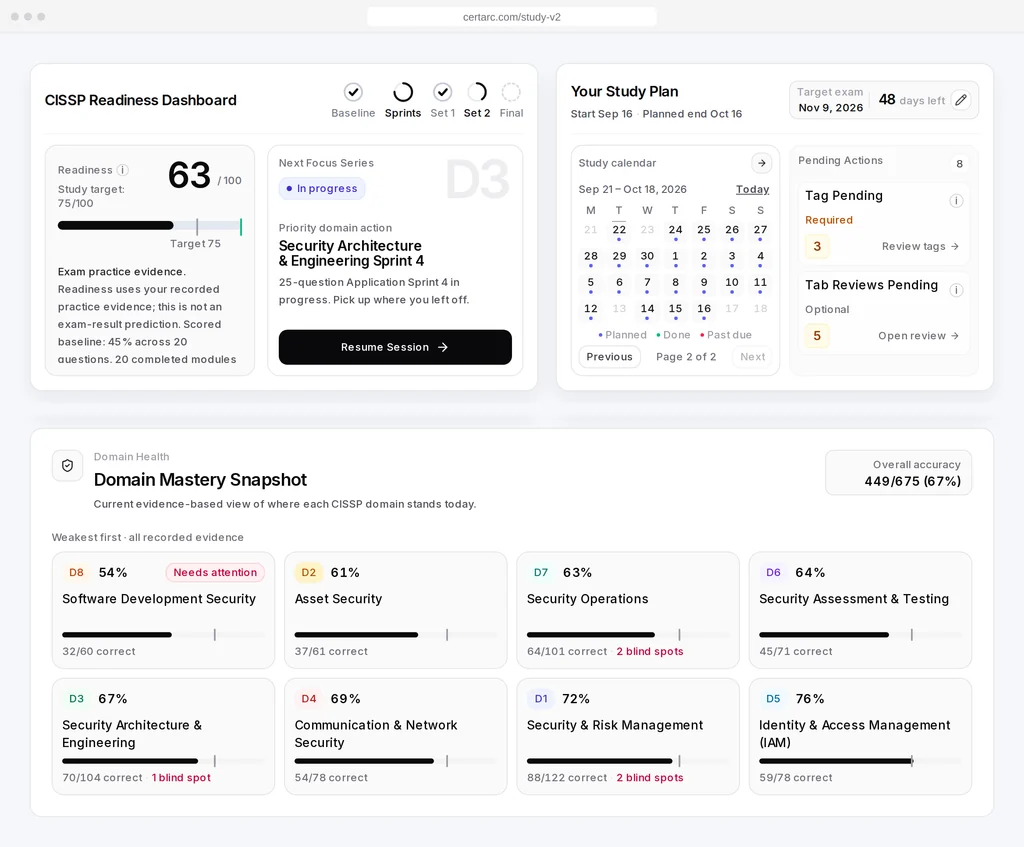
No. It is one study signal alongside eight-domain coverage, unfamiliar-item stability, confidence calibration, pacing, and review quality.