CISSP practice
What makes CISSP practice questions genuinely useful?
Direct answer
A CISSP practice question is useful when it is original, tied to a domain of the current ISC2 outline, built on a scenario with one defensible best answer, and explained option by option, so you learn why each wrong choice fails. Audit any bank before you pay for it or spend weeks in it: answer a small unseen set, rate your confidence first, then grade the explanations against the rubric below. Item count and repeat scores prove neither quality.
An audit rubric for any CISSP question bank
| Criterion | What good looks like | Red flag |
|---|---|---|
| Where items come from | Written for practice by the provider, who says so plainly | Sold as actual, real or recalled exam questions |
| Outline edition | Each item names its domain, and the provider states which ISC2 outline edition it follows: the one effective 15 April 2024 until the revised outline takes over on 15 April 2027 | No domain shown, or domain names that do not match ISC2's eight |
| Spread across domains | A mixed set leans the way ISC2 weights the exam: Security and Risk Management heaviest at 16%, Asset Security and Software Development Security lightest at 10% | A 'mixed' set that is mostly cryptography and networking |
| One best answer | Two careful readers pick the same option for the same stated reason | You can defend two options and the explanation only repeats the key |
| A decision, not a definition | The stem gives a role, a goal and a constraint, and the answer turns on them | A glossary lookup with a company name added |
| Wrong options explained | Each distractor gets its own reason: what makes it tempting and which fact rules it out | One paragraph on the right option; the other three called 'incorrect' |
| A rule you can carry | The lesson can be written as one sentence that applies to a different stem | The explanation only makes sense with the same stem in front of you |
| Fresh items for re-testing | New forms or unseen sets when you check whether a weak area improved | The same items come back, so the score climbs with familiarity |
Auditing a twelve-question sample
You are deciding whether to buy a bank and try its twelve free questions. Before each reveal you write down Confident, Unsure or Guess. You get nine right. Then you grade the explanations: seven of the twelve explain only the keyed option, two items have two answers you can defend (one asks for the first action after a ransomware alert, and both isolating the host and invoking the incident response plan fit the stem), and no item names a domain.
Nine of twelve says little about the bank or about you, and three of those nine were marked Guess. The audit is what decides: the bank fails 'wrong options explained' on seven items, 'one best answer' on two, and 'outline edition' on all twelve. Studying from it would train you to recognise its keys rather than to choose between plausible options. Keep looking, and run the same twelve-item audit on the next candidate so the comparison is fair.
How to run the audit in one sitting
Take ten to fifteen unseen questions, commit to an answer and a confidence rating before each reveal, and grade the explanations only after the set is finished.
Grading as you go biases you: a bank that just told you that you were right reads as a good bank. Finish the set first, then open each explanation and score it against the eight rubric rows. Record a row as a finding as soon as any item in the sample fails it, because a sample this small cannot show a rate, only whether a problem exists.
Choose the sample from more than one domain. A provider's free set is often its showcase; if the free items already fail 'one best answer' or 'wrong options explained', the paid items are unlikely to be better.
- Before each reveal: write your option and Confident, Unsure or Guess.
- After the set: score each explanation against the rubric rows.
- For each miss: write the one-sentence rule the explanation should have given you.
Reading an explanation for what it teaches
A useful explanation tells you why the tempting option is tempting and names the single fact in the stem that rules it out.
CISSP options are usually all true statements about security. What separates them is fit: who is acting, what they are allowed to decide, what has already happened, and what the organisation needs. An explanation that only says 'B is correct because encryption protects confidentiality' leaves you unable to reject the next stem's equally true distractor.
Test each explanation by covering the stem and reading the explanation alone. If you can still state the rule (for example, 'when the stem names the data owner, classification decisions sit with them, not the custodian'), the explanation teaches something portable. If the explanation is meaningless without the stem, it teaches only that item.
Why item count and repeat scores mislead
Thousands of items and a rising score on a bank you have already seen measure exposure, not judgment.
A large bank with thin explanations gives you many keys to memorise and few reasons to keep. Repeat passes make it worse: by the second pass you are recognising wording, and the score climbs even when the underlying choice would still go wrong on a new stem.
Confidence ratings expose this. Correct answers you marked Guess are luck you should not bank. Wrong answers you marked Confident show a rule you hold firmly and apply wrongly, so review those misses before anything else.
What CertArc's own review shows you
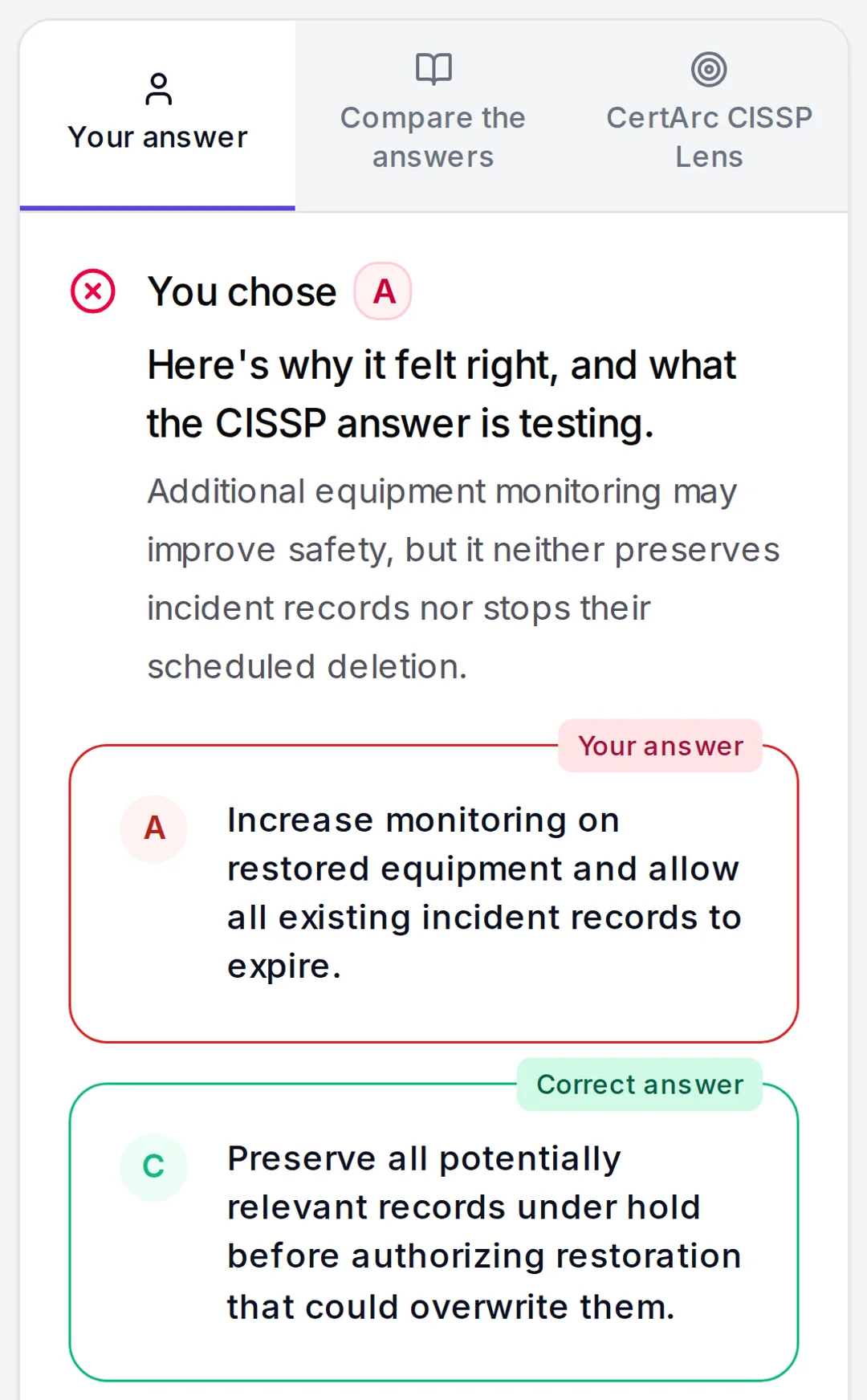
After each answer in a study sprint, and for every question once a practice or mock exam ends, CertArc shows three tabs: Your answer, Compare the answers, and CertArc CISSP Lens.
Compare the answers puts every option on its own card, labelled Correct answer or Distractor. The correct card says why this wins; each distractor card says why this may look right and where it breaks, with a key takeaway. When you miss, Your answer explains why your choice felt right, why it is not the CISSP answer, and gives a carry-forward rule. You rate Confident, Unsure or Guess before the answer is revealed.
Each CertArc CISSP question is mapped to a domain of the outline effective 15 April 2024. You can run the same audit on CertArc's 10 public sample questions, which use the same review, before you sign up. Apply the rubric to us exactly as you would to anyone else.
Where this rubric stops
The rubric tells you whether a bank teaches decisions well; it cannot certify that every key is technically right or tell you whether you are ready to pass.
Checking an individual item's technical accuracy takes subject knowledge and the source material, which is a different job. CertArc's standard for writing and checking its own items is set out on the question-quality page linked below. Your audit score for a bank is about the bank; your score on its questions is study evidence about you, and neither is an exam forecast.
Sources and fact check
Source checked: 2026-10-27
- CertArc is an independent exam-preparation platform and is not affiliated with or endorsed by ISC2.
- CertArc uses original practice questions, not live or recalled exam items, and does not reproduce the CISSP CAT algorithm.
- Practice performance is study evidence, not a pass prediction or guarantee.
Frequently asked questions
What makes CISSP practice questions genuinely useful?
A CISSP practice question is useful when it is original, tied to a domain of the current ISC2 outline, built on a scenario with one defensible best answer, and explained option by option, so you learn why each wrong choice fails. Audit any bank before you pay for it or spend weeks in it: answer a small unseen set, rate your confidence first, then grade the explanations against the rubric below. Item count and repeat scores prove neither quality.
How many questions do I need to judge a CISSP question bank?
Ten to fifteen unseen questions from several domains are enough to grade the explanations, because one ambiguous key or one unexplained distractor is already a finding. They are far too few to say anything about your own exam prospects.
Should a CISSP bank already follow the 2027 outline?
Not yet. ISC2's current outline took effect on 15 April 2024 and the revised one takes effect on 15 April 2027. Until then, items should follow the 2024 outline; ask a provider when and how it will move. CertArc's CISSP bank is mapped to the 2024 outline.
Is a harder CISSP question bank a better one?
Not by itself. ISC2's adaptive exam picks each item so that you have about a 50% chance of answering it correctly, so the real exam feels hard. A bank that feels hard because two answers fit the stem is failing the 'one best answer' check, not preparing you better.
Are recalled or 'actual exam' CISSP questions worth using?
No. You cannot check them against the outline, their keys are often disputed, and they train recall of a remembered stem rather than the choice between plausible options that the exam tests. Treat that label as the first red flag in the rubric.