CISSP practice
How should you use a CISSP practice exam?
Direct answer
Use a CISSP practice exam to test pace and mixed-domain judgment on an unfamiliar form, then review it. ISC2's exam is adaptive in every language, 100 to 150 items in up to three hours, so no fixed form reproduces it. CertArc's CISSP practice exams are 30 questions in one mixed-domain session with a running clock, and free access includes one, as well as the 25-question baseline.
Using the question clock in one practice form
| Moment | What the clock shows | What to do |
|---|---|---|
| Before the first question | Each question has its own clock, which starts again at the next one | Decide now what you will do with an item you cannot settle: pick your best option, mark it Unsure, move on. |
| On a long scenario | Time on this item climbing past your usual | Stop rereading the whole stem. Read the final sentence first, then the facts it depends on. |
| On an item you still cannot settle | Time still climbing after a second read | Choose a reasoned answer and mark it Guess, so the review can tell it apart from knowledge. |
| In the review | The time you spent on each question | Find your slowest items and note whether the delay was reading, recall or doubt, and which domain they came from. |
| Across forms | Whether the same kinds of item stay slow | ISC2 gives up to three hours whether you get 100 items or 150, so build a pace you could hold for all 150. |
Reviewing one practice exam
A network architect takes her second CISSP practice exam after two weeks of Domain 4 and Domain 5 sprints. Her score is higher than on her first attempt. Of her nine misses, five were marked Confident, and four of those five asked who should decide or approve something, not how to configure it. Her two slowest questions were Domain 8 items she marked Unsure and got right.
The total is the least useful number on the result. The five Confident misses come first: she holds a rule firmly and applies it at the wrong level, choosing the engineer's action when the stem asks for management's. CertArc's miss reason for that is 'Used the wrong decision level'. The slow, correct Domain 8 items are a pace cost to watch, not a knowledge gap. Her next steps are a Domain 1 sprint on governance roles, then a different practice form, not a retake of this one.
Pacing one question at a time
Use the clock to stop one item eating your time, and the review's time on each question to see where your pace goes.
A CertArc CISSP practice exam shows a running clock for the question in front of you; it starts again at each new question and sets no allowance per question. ISC2 allows up to three hours for 100 to 150 items, and you will not know your length in advance. The pace worth practising is one you could hold for the longest exam, without a quota for each item.
A fixed allowance per item is the wrong target. CISSP stems vary from two lines to a long scenario, and a quota per item makes you rush the long ones. Watch instead for single items that run well past your usual time, settle them with your best option and an Unsure mark, and spend the rest of your attention on the stems.
How to work through the review
Review in order of what the result can teach: Confident misses first, then Unsure answers, then the slowest items, and the total last.
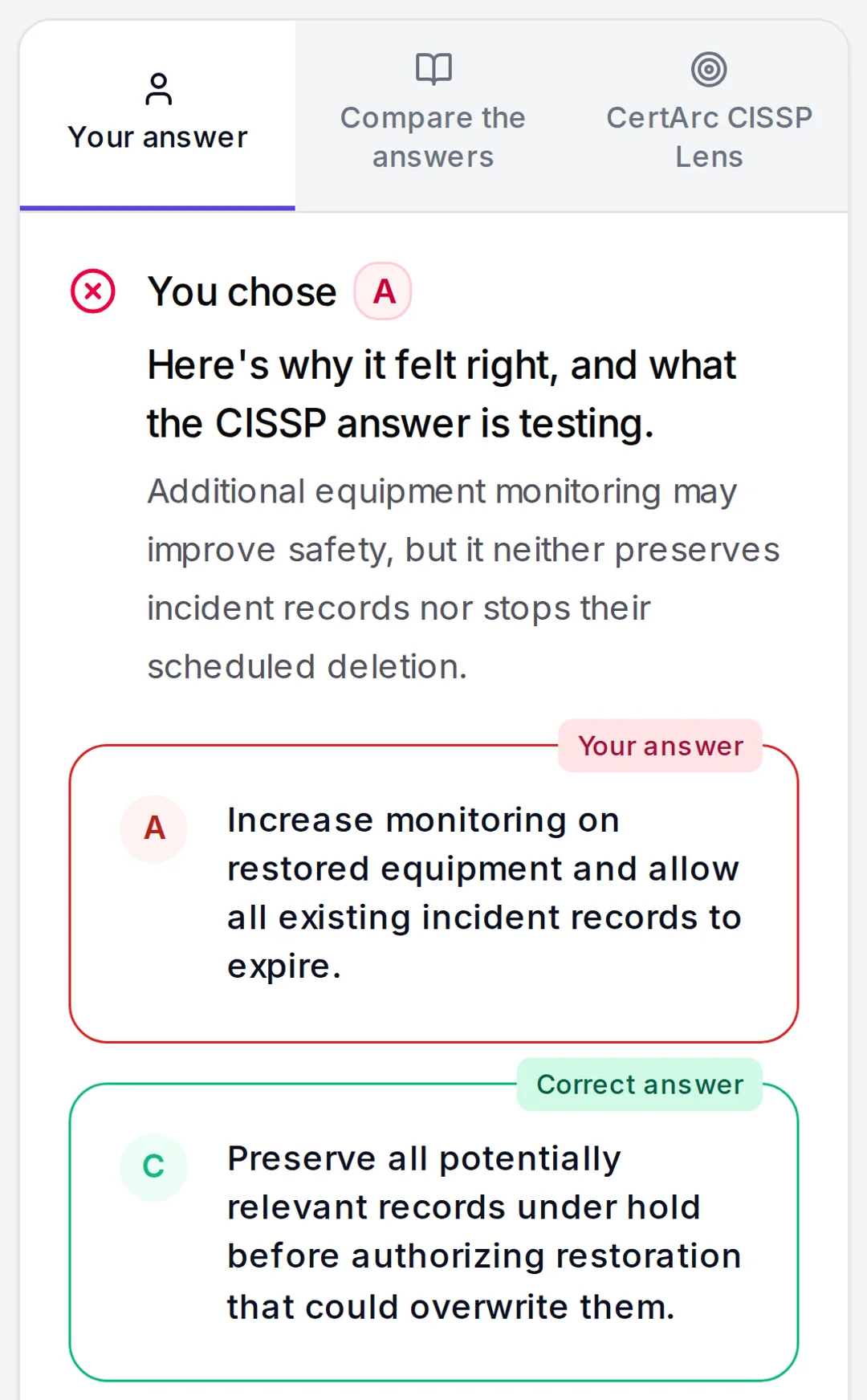
During a CertArc practice exam no answer is revealed; you choose Confident, Unsure or Guess to submit each one. That keeps the form honest and saves the learning for afterwards. In the review, each question has three tabs, Your answer, Compare the answers and CertArc CISSP Lens, the same as in study sessions.
Confident misses are where your reasoning is wrong and you do not know it. Unsure answers that were correct show rules you half-hold. Slow items show where reading or doubt costs time. Write one sentence per miss stating the rule you will apply next time, then tag the miss with the reason that fits; CertArc's CISSP reasons include 'Used the wrong decision level' and 'Missed FIRST / NEXT / BEST / MOST'.
- Confident and Incorrect: rework the rule before anything else.
- Unsure and Correct: confirm the deciding fact so the next one is quicker.
- Slowest items: note whether the delay was reading, recall or doubt.
What a fixed form cannot tell you about ISC2's adaptive exam
A practice form gives everyone the same questions; ISC2's CAT picks each item from your previous answers, so the two scores are not comparable.
ISC2's exam starts below the passing standard and then chooses items you have about a 50% chance of answering correctly. It includes 25 unscored pretest items you cannot identify, does not let you go back to change an answer, and reports pass or fail without a numerical score. A percentage on a fixed form measures something different: how you did on that set of items, on that day.
Use the percentage to compare your own forms over time, at similar spacing and under the same conditions. Do not convert it into a scaled score or read it as a forecast of your result.
Where practice exams sit between study sprints
Take a practice exam after a block of domain study, as a mixed check of whether that study holds up next to the other domains.
Sprints concentrate on one domain at a time, which is good for learning and poor for testing judgment, because you know which domain the next question comes from. A practice exam mixes domains in one sitting, which is closer to the decision you face on exam day. Taking one after every few sprints shows whether new knowledge survives that mixing.
The CISSP catalogue has 10 practice exams of 30 questions each, so space them out rather than using several in a week. Free access includes the 25-question baseline, the first sprint in each domain and the first practice exam. When short forms feel routine, the longer mock exams test whether your pace and judgment last.
Sources and fact check
Source checked: 2026-10-27
- CertArc is an independent exam-preparation platform and is not affiliated with or endorsed by ISC2.
- CertArc uses original practice questions, not live or recalled exam items, and does not reproduce the CISSP CAT algorithm.
- Practice performance is study evidence, not a pass prediction or guarantee.
Frequently asked questions
How should you use a CISSP practice exam?
Use a CISSP practice exam to test pace and mixed-domain judgment on an unfamiliar form, then review it. ISC2's exam is adaptive in every language, 100 to 150 items in up to three hours, so no fixed form reproduces it. CertArc's CISSP practice exams are 30 questions in one mixed-domain session with a running clock, and free access includes one, as well as the 25-question baseline.
How should I use the clock in a CertArc CISSP practice exam?
As a guard against one item eating your time. The clock shows how long you have spent on the current question and starts again at the next one. After the form, the review shows your time on each question, so you can see which items and domains slow you. ISC2's exam allows up to three hours for 100 to 150 items, so the pace to build is one you could hold for all 150.
Does a CertArc practice exam show the answer after each question?
No. You pick an option and then Confident, Unsure or Guess to submit it, and no answer is revealed until the form is finished. The full review, with every option explained, opens afterwards.
Does the timer stop if I step away?
No. A CertArc exam timer keeps running when you are idle; after a pause the app asks 'Still there?' and reminds you the timer is still going, as on the real exam. Take a practice exam when you can give it one uninterrupted sitting.
Should I retake a practice exam to see whether I improved?
Use a different form. Once you have seen a form's questions and explanations, a second attempt measures memory of that form as much as judgment, so the improvement it shows is hard to trust.