CISSP practice
What should a CISSP mock exam measure?
Direct answer
A CISSP mock exam should measure whether your judgment holds as a long sitting wears on: how your pace changes by stage, whether Confident answers start turning out Incorrect late on, and what a break costs in time. CertArc's CISSP mocks are its longest form, 50 questions in one sitting, while ISC2's exam runs 100 to 150 items in up to three hours, so treat a mock as a stamina rehearsal, not a replica.
What to watch at each stage of a mock
| Stage | What to watch | What it tells you |
|---|---|---|
| Opening quarter | Whether the first items take longest while you settle in | How much warm-up you need; on exam day the clock starts with the first item |
| Middle | A steady rhythm and how many answers you mark Unsure | Your working pace when nothing is going wrong |
| Halfway break, if you take one | How long you were away; ISC2 counts breaks inside your three hours | Whether a short break gives back more focus than it takes in time |
| Final quarter | Confident answers that come back Incorrect, and technical fixes chosen for management questions | Whether tiredness, rather than knowledge, is changing your choices |
| Afterwards | Accuracy and confidence in the first half against the second half | Whether stamina is the next thing to train, or a domain is |
A mock that fades in the second half
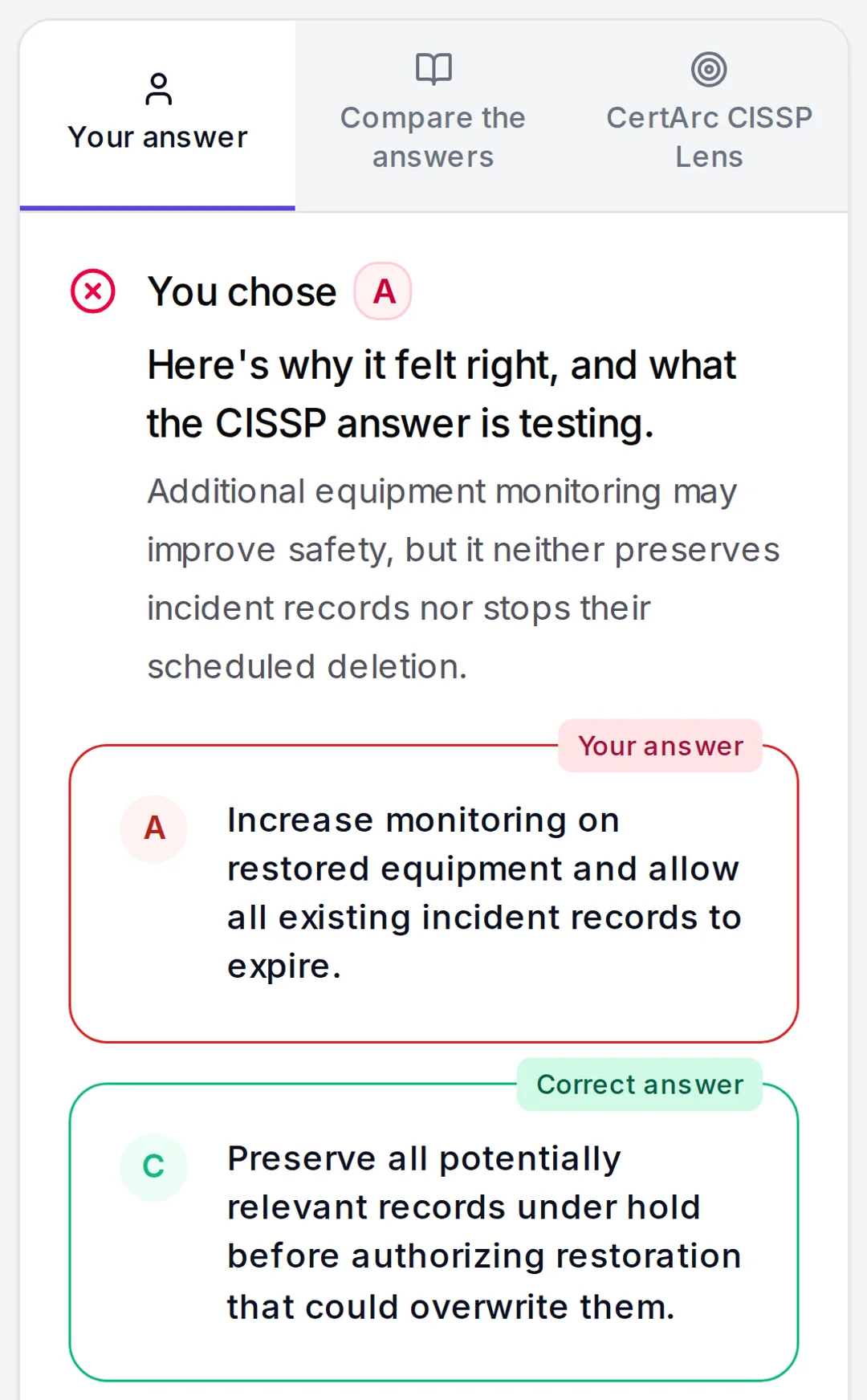
A SOC team lead takes her second CISSP mock three weeks before her exam date. In the first half she misses three questions, mostly marked Unsure. In the second half she misses nine, five of them marked Confident, and four of those five asked what management should do first after an incident; she chose the containment step she would run herself at work. In the review she answers each of the four correctly within a minute.
Her knowledge is not the problem: rested, she gets the four right quickly. What changed is late-session judgment, which a single total hides. Splitting the result into halves shows it. Before her next mock she rehearses a two-minute break at the halfway point and a reset habit for every stem after it: name who is acting and what they are being asked to decide before reading the options. She takes a different mock a week later and compares the halves again, not the total.
How a CertArc mock differs from a practice exam
A mock is longer, there are fewer of them, and it is not part of free access; it is built for stamina, while the shorter practice exam is built for regular mixed checks.
Both show a running clock, both mix domains in one sitting, and neither reveals answers until you finish. The difference is the length of the sitting, which is what a mock is for: the later questions arrive after a long stretch of concentration, as they will on exam day.
- Mock exam: 50 questions, 5 forms, paid plan.
- Practice exam: 30 questions, 10 forms, the first one included in free access.
- ISC2's exam: 100 to 150 items in up to three hours, with breaks counted inside that time.
Building toward a three-hour sitting
No CertArc form is full length, so build stamina in steps: short forms first, then a mock, then a mock and a practice exam back to back.
ISC2's minimum sitting is 100 items, so even the shortest real exam is longer than any single CertArc form. A mock followed straight away by a practice exam is 50 plus 30 questions in one session, which gets closer to that minimum. Do it once or twice in the final weeks, at the time of day you are booked to sit.
Pace matters more over a long sitting. ISC2 fails a candidate automatically who has not answered 75 scored and 25 pretest items when time runs out, so a slow early stretch is a real risk. The review shows your time on each question, so compare the first half with the second; a slow early stretch shows up there before it costs you on exam day.
Breaks and the running clock
ISC2 lets you take as many breaks as you like, but every minute of them comes out of your three hours, so rehearse the break as part of the timing.
A CertArc exam timer also keeps running when you step away; after a pause the app asks whether you are still there and reminds you the timer is going. That makes a mock a fair place to test a break. Try one planned stop at the halfway point, for water and a stretch, and see whether your second-half accuracy improves by more than the minutes it costs.
Decide your break plan before the exam, not in the middle of a hard run of questions, when stopping feels like escape and costs more.
Reading late-session work in the review
Compare the second half of the mock with the first, and look for mistakes you would not make when rested.
Late-session drift looks different from a knowledge gap. Misses spread across domains, more of them marked Confident, and the chosen option is often the familiar action from your own job. If you can answer a late miss correctly as soon as you see it again, treat it as a stamina miss rather than starting a new round of domain study. Tagging misses with CertArc's CISSP miss reasons, such as 'Used the wrong decision level' or 'Missed a constraint, scope, or boundary', shows which late misses share a cause.
Why the end of the real exam feels hard
ISC2's adaptive exam keeps choosing items you have about a 50% chance of getting right, so a hard late run is expected, not a sign you are failing.
ISC2 says candidates should expect every item to be challenging and that many feel they did poorly for that reason. Pretest items are mixed in and cannot be told apart. A mock teaches the habit that matters here: give each late item the same careful read as the first, and do not let a run of hard questions speed you up or slow you down.
Sources and fact check
Source checked: 2026-10-27
- CertArc is an independent exam-preparation platform and is not affiliated with or endorsed by ISC2.
- CertArc uses original practice questions, not live or recalled exam items, and does not reproduce the CISSP CAT algorithm.
- Practice performance is study evidence, not a pass prediction or guarantee.
Frequently asked questions
What should a CISSP mock exam measure?
A CISSP mock exam should measure whether your judgment holds as a long sitting wears on: how your pace changes by stage, whether Confident answers start turning out Incorrect late on, and what a break costs in time. CertArc's CISSP mocks are its longest form, 50 questions in one sitting, while ISC2's exam runs 100 to 150 items in up to three hours, so treat a mock as a stamina rehearsal, not a replica.
Are CertArc's CISSP mock exams free?
No. Free access covers the 25-question baseline, the first sprint in each domain and the first practice exam. The 5 mock exams need a paid plan.
When should I take my first CISSP mock?
After you have reviewed a few shorter practice exams well and your misses there are no longer mostly basic gaps. A mock taken too early mostly re-finds weak domains you could have found in a shorter form, and it uses up one of a small number of forms.
Should I take a mock in the last week before the exam?
If you take one, take it early enough in the week to review it fully and rest afterwards. A long sitting followed by a rushed review the night before gives you fatigue without the lesson.
Can a mock exam score tell me whether I will pass?
No. A fixed form and ISC2's adaptive exam are scored differently, and ISC2 reports pass or fail without a numerical score. Use a mock to compare your own sittings, especially first half against second half.