Last updated:
CISSP diagnostic
What can a free CISSP diagnostic assessment tell you?
Direct answer
A short CISSP diagnostic can identify study priorities across the eight domains and reveal recurring reasoning errors, but it cannot certify readiness or predict a pass. Read the baseline as directional evidence: domain spread, confidence calibration, error category, and explanation quality matter more than one percentage. First, answer the baseline without notes and record confidence before viewing explanations, then verify the decision on unfamiliar scenarios and explain why the strongest distractor loses.
a CISSP diagnostic assessment: a practical decision framework
| Check | How to use it |
|---|---|
| Objective | Read the baseline as directional evidence: domain spread, confidence calibration, error category, and explanation quality matter more than one percentage. |
| First move | answer the baseline without notes and record confidence before viewing explanations |
| Common trap | Converting twenty questions into a universal readiness score or ignoring a weak domain because the total percentage looks comfortable. |
a CISSP diagnostic assessment in practice
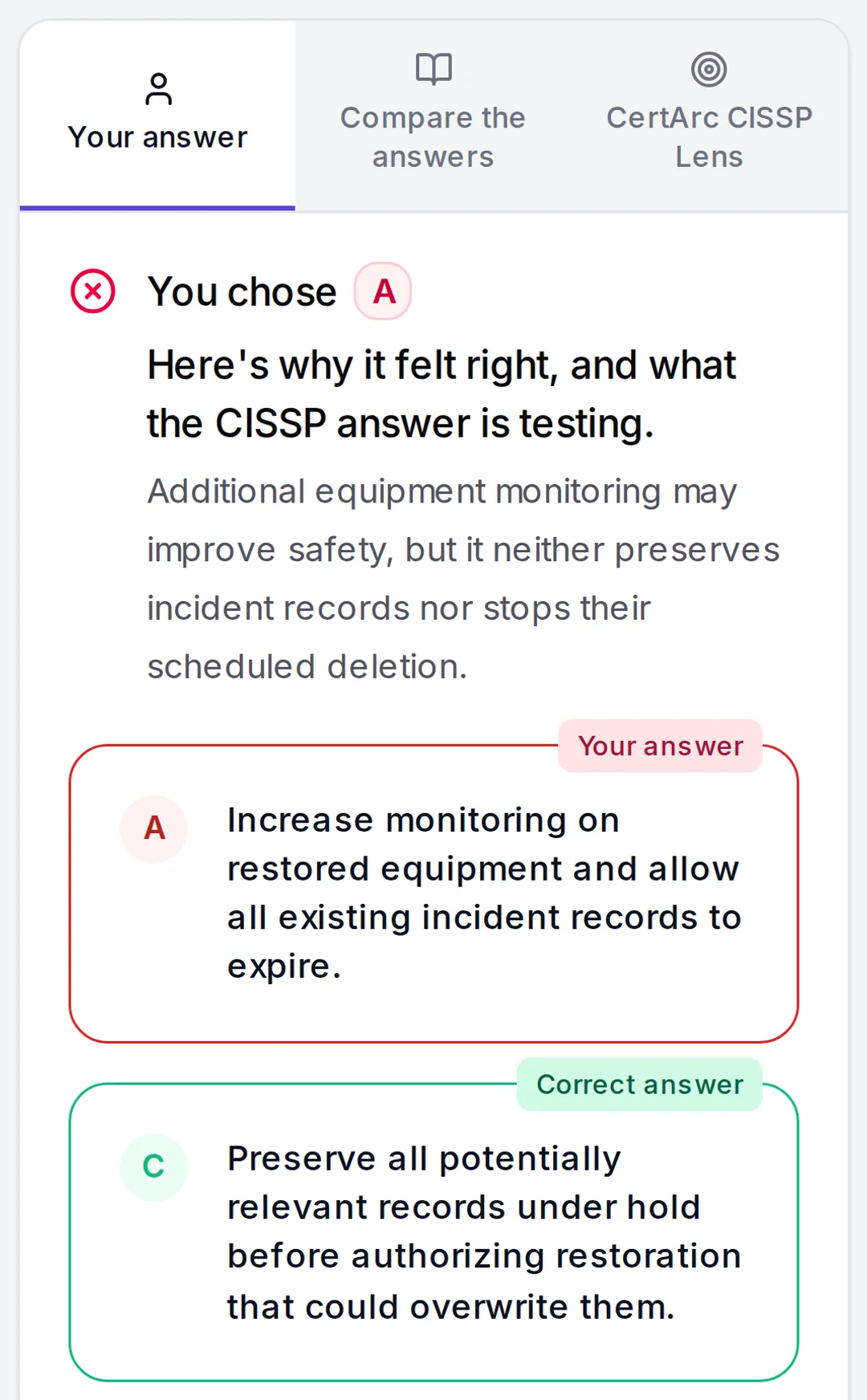
A candidate scores well overall on a twenty-question baseline but is confidently wrong on both access-governance scenarios and one evidence-preservation question.
The small sample cannot predict the exam, but the confident misses are actionable: prioritize authority and sequence practice before chasing a higher aggregate score.
What matters most for a CISSP diagnostic assessment
Read the baseline as directional evidence: domain spread, confidence calibration, error category, and explanation quality matter more than one percentage.
A short CISSP diagnostic can identify study priorities across the eight domains and reveal recurring reasoning errors, but it cannot certify readiness or predict a pass. The useful question is not whether an isolated fact looks familiar, but whether you can apply it under the actor, authority, objective, qualifier, and constraints in the scenario.
How to work on a CISSP diagnostic assessment
answer the baseline without notes and record confidence before viewing explanations
For a CISSP diagnostic assessment, preserve first-attempt evidence and confidence before reading the rationale. Review every option, name the transferable decision rule, and wait for unfamiliar evidence before deciding that the weakness is repaired.
- Name the actor and the authority that actor holds.
- Underline the qualifier and the required business or security outcome.
- Check sequence, scope, constraints, and residual risk before choosing.
The mistake that distorts a CISSP diagnostic assessment
Converting twenty questions into a universal readiness score or ignoring a weak domain because the total percentage looks comfortable.
This error can survive repeated question practice when review stops at the correct letter. Rework the item until you can state the transferable rule without quoting the stem.
What useful progress looks like for a CISSP diagnostic assessment
The small sample cannot predict the exam, but the confident misses are actionable: prioritize authority and sequence practice before chasing a higher aggregate score.
Retest a CISSP diagnostic assessment with a changed actor, qualifier, constraint, or domain context. Keep the result only when the same reasoning survives unfamiliar wording and you can explain what evidence would make another option stronger.
- Use an unfamiliar scenario rather than a repeated item.
- Record confidence before opening the explanation.
- Name the evidence that would reverse the decision.
Sources and fact check
Source checked: 2026-08-24
- CertArc is an independent exam-preparation platform and is not affiliated with or endorsed by ISC2.
- CertArc uses original practice questions, not live or recalled exam items, and does not reproduce the CISSP CAT algorithm.
- Practice performance is study evidence, not a pass prediction or guarantee.
Frequently asked questions
What can a free CISSP diagnostic assessment tell you?
A short CISSP diagnostic can identify study priorities across the eight domains and reveal recurring reasoning errors, but it cannot certify readiness or predict a pass. Read the baseline as directional evidence: domain spread, confidence calibration, error category, and explanation quality matter more than one percentage. First, answer the baseline without notes and record confidence before viewing explanations, then verify the decision on unfamiliar scenarios and explain why the strongest distractor loses.
What should I do first with a CISSP diagnostic assessment?
Answer the baseline without notes and record confidence before viewing explanations. Capture first-attempt evidence before adding more repeated questions or materials.
What does useful a CISSP diagnostic assessment review include?
Read the baseline as directional evidence: domain spread, confidence calibration, error category, and explanation quality matter more than one percentage. Review every option, confidence, and the rule that should transfer to a changed scenario.
What commonly distorts a CISSP diagnostic assessment results?
Converting twenty questions into a universal readiness score or ignoring a weak domain because the total percentage looks comfortable. Use unfamiliar items and consistent conditions to reduce that distortion.
Does a CISSP diagnostic assessment performance predict a CISSP pass?
No. It is one study signal alongside eight-domain coverage, unfamiliar-item stability, confidence calibration, pacing, and review quality.