Last updated:
CISSP decision trap
Should you fix the immediate problem or investigate root cause first?
Direct answer
The correct sequence depends on harm and phase: stabilize urgent impact when required, preserve evidence, then investigate and remove root causes through controlled corrective action. Separate containment, restoration, eradication, and long-term prevention instead of asking which is universally more important. First, identify whether active harm, evidence loss, or service safety creates an immediate priority, then verify the decision on unfamiliar scenarios and explain why the strongest distractor loses.
immediate stabilization versus root cause: a practical decision framework
| Check | How to use it |
|---|---|
| Objective | Separate containment, restoration, eradication, and long-term prevention instead of asking which is universally more important. |
| First move | identify whether active harm, evidence loss, or service safety creates an immediate priority |
| Common trap | Launching a long investigation during preventable harm or applying a destructive fix that erases evidence and hides recurrence. |
immediate stabilization versus root cause in practice
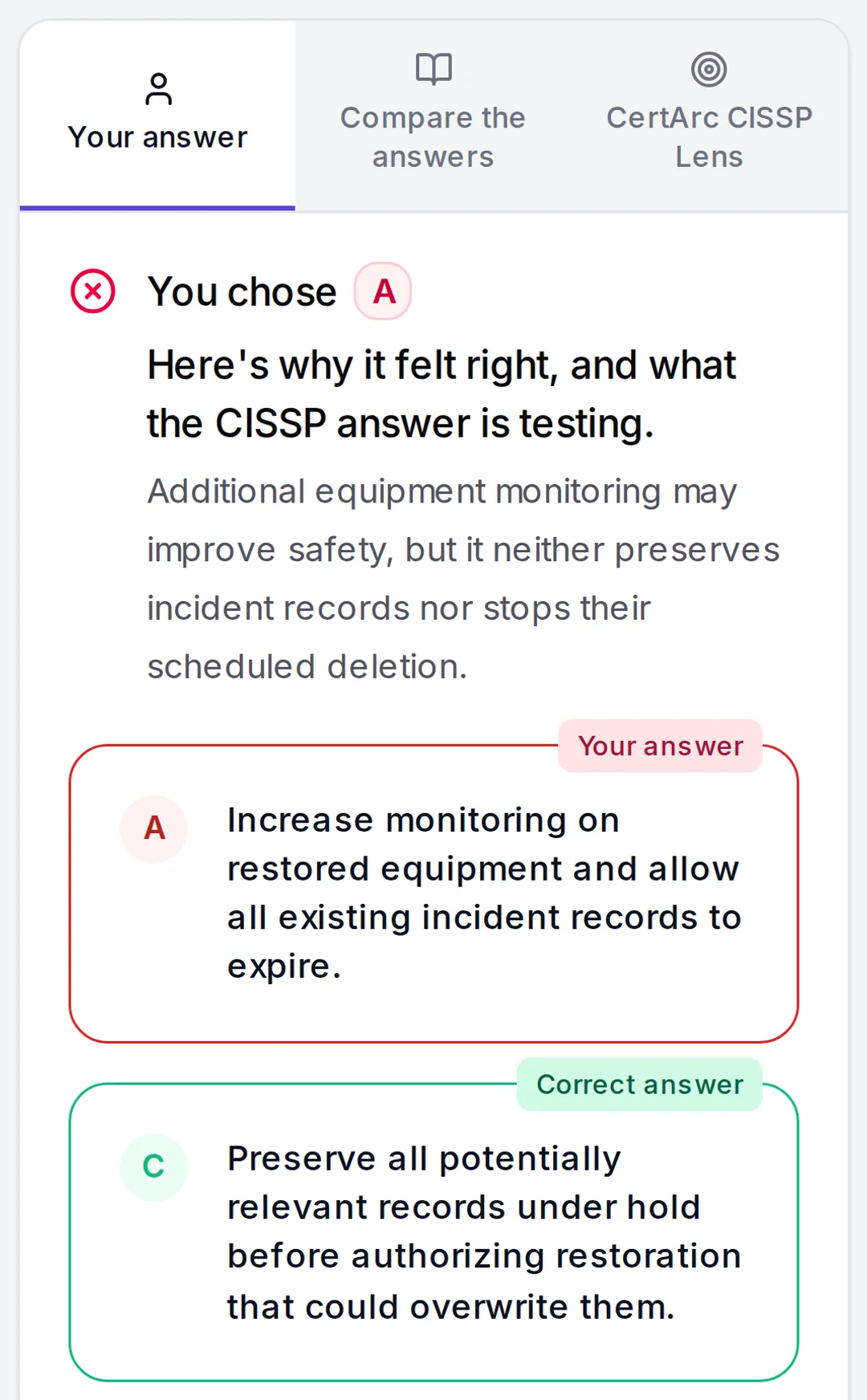
A production service is actively spreading malicious traffic, and rebuilding it immediately would stop the traffic but destroy volatile evidence needed for the investigation.
Use authorized containment that limits harm and preserves required evidence, then investigate, eradicate, restore, and complete root-cause corrective work in sequence.
What matters most for immediate stabilization versus root cause
Separate containment, restoration, eradication, and long-term prevention instead of asking which is universally more important.
The correct sequence depends on harm and phase: stabilize urgent impact when required, preserve evidence, then investigate and remove root causes through controlled corrective action. The useful question is not whether an isolated fact looks familiar, but whether you can apply it under the actor, authority, objective, qualifier, and constraints in the scenario.
How to work on immediate stabilization versus root cause
identify whether active harm, evidence loss, or service safety creates an immediate priority
For immediate stabilization versus root cause, state the rule before opening the rationale. Compare the authority, timing, scope, and objective assumed by every option, then record the exact fact that makes the tempting choice weaker.
- Name the actor and the authority that actor holds.
- Underline the qualifier and the required business or security outcome.
- Check sequence, scope, constraints, and residual risk before choosing.
The mistake that distorts immediate stabilization versus root cause
Launching a long investigation during preventable harm or applying a destructive fix that erases evidence and hides recurrence.
This error can survive repeated question practice when review stops at the correct letter. Rework the item until you can state the transferable rule without quoting the stem.
How to know the immediate stabilization versus root cause rule transfers
Use authorized containment that limits harm and preserves required evidence, then investigate, eradicate, restore, and complete root-cause corrective work in sequence.
Retest immediate stabilization versus root cause with a changed actor, qualifier, constraint, or domain context. Keep the result only when the same reasoning survives unfamiliar wording and you can explain what evidence would make another option stronger.
- Use an unfamiliar scenario rather than a repeated item.
- Record confidence before opening the explanation.
- Name the evidence that would reverse the decision.
Sources and fact check
Source checked: 2026-08-24
- CertArc is an independent exam-preparation platform and is not affiliated with or endorsed by ISC2.
- CertArc uses original practice questions, not live or recalled exam items, and does not reproduce the CISSP CAT algorithm.
- Practice performance is study evidence, not a pass prediction or guarantee.
Frequently asked questions
Should you fix the immediate problem or investigate root cause first?
The correct sequence depends on harm and phase: stabilize urgent impact when required, preserve evidence, then investigate and remove root causes through controlled corrective action. Separate containment, restoration, eradication, and long-term prevention instead of asking which is universally more important. First, identify whether active harm, evidence loss, or service safety creates an immediate priority, then verify the decision on unfamiliar scenarios and explain why the strongest distractor loses.
Which clue matters most in immediate stabilization versus root cause questions?
Separate containment, restoration, eradication, and long-term prevention instead of asking which is universally more important. The decisive clue is usually the fact that changes authority, sequence, scope, or the required outcome.
Why does the tempting answer lose in immediate stabilization versus root cause?
Launching a long investigation during preventable harm or applying a destructive fix that erases evidence and hides recurrence. Compare the tempting option with the stem's actor, timing, authority, and objective before reviewing the correct letter.
How should I practise immediate stabilization versus root cause without memorizing?
Identify whether active harm, evidence loss, or service safety creates an immediate priority. Then change one material fact and explain whether the answer should change.
Does one correct immediate stabilization versus root cause answer prove mastery?
No. Mastery requires the rule to survive unfamiliar wording, different actors, cross-domain context, and a strong distractor.